A customer uses an AOS-10 architecture managed by HPE Aruba Networking Central. HPE Aruba Networking infrastructure devices authenticate clients to an HPE Aruba Networking ClearPass cluster.
In HPE Aruba Networking Central, you are reviewing network traffic flows for a wireless IoT device categorized as "Raspberry Pi" clients. You observe SSH traffic. You then examine several additional wireless IoT clients and find that they are also sending SSH.
Refer to the scenario.
You need a fast way to find a list of all IoT clients that have used SSH.
What step can you take?
You are helping a developer create a custom NAE script for an AOS-CX switch. What information might you need to provide so the developer can define the parameters correctly?
You are assisting a company with adding HPE Aruba Networking ClearPass to its network, which uses HPE Aruba Networking network infrastructure devices.
The company already has a Windows domain and Windows CA. The Windows CA issues certificates to domain computers, domain users, and servers such as domain controllers.
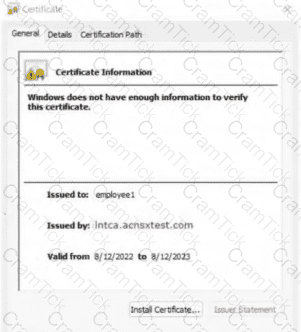
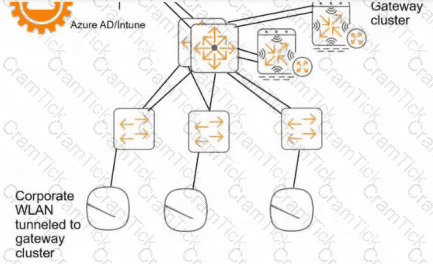
Refer to the scenario. On CPPM, you are creating the authentication source. You have configured the settings displayed on the tab and have not changed any other settings.
Authentication Sources - UniversityAD
Hostname: ad.acnsxtest.com
Connection Security: AD over SSL
Port: 636
Verify Server Certificate: [X] Enable
Bind DN: bind@acnsxtest.com
NetBIOS Domain Name: ACNSXTEST
Base DN: dc=acnsxtest,dc=com
Search Scope: SubTree Search
User Certificate: userCertificate
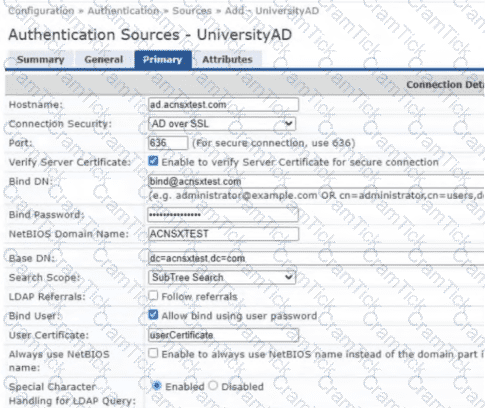
What else must you do to help authentication proceed correctly?
A customer has an AOS-10 architecture managed by HPE Aruba Networking Central. HPE Aruba Networking infrastructure devices authenticate clients against an HPE Aruba Networking ClearPass cluster.
In HPE Aruba Networking Central, you are reviewing network traffic flows for a wireless IoT device categorized as a “Raspberry Pi” client. You observe SSH traffic. You then review several additional wireless IoT clients and find that they are also sending SSH.
Refer to the scenario.
You are assisting the customer in assessing ways to mitigate the potential threat detected. For the foreseeable future, until the security team has addressed the threat, the company wants to block most traffic from any IoT client detected sending SSH traffic. The company does want to allow limited access for these clients so that administrators can remediate them remotely.
What action should you take?
A company wants its AOS-CX switches to obtain certificates from ClearPass Onboard and use those certificates to implement RadSec with ClearPass Policy Manager (CPPM).
ClearPass Onboard has a CA with EST enabled and this EST URL: `[https://cp1.acnsxtest.com/.well-known/est/ca:2](https://cp1.acnsxtest.com/.well-known/est/ca:2)`
ClearPass Guest has an account whose username is `switchcorp123`. (Assume CPPM also has a valid service to authenticate users who access the EST application.)
CPPM has a network-device account for the switches with RadSec enabled. The RadSec settings validate by CN or SAN using this regex: `switchcorp123`
ClearPass has these certificates:
* HTTPS certificate signed by DigiCert
* RadSec certificate signed by DigiCert
* RADIUS/EAP certificate signed by MyDomainCA
This configuration is on the AOS-CX switches:
```text
crypto pki est-profile est1
url https://clearpass1.acnsxtest.com/.well-known/est/ca:2
username switchcorp123
password plaintext %FY212h & zaTk
vrf default
exit
crypto pki certificate cert1
subject switchcorp123
enroll est-profile onboard
crypto pki application radsec-client certificate cert1
```
The switches’ TA-profile list includes DigiCert.
Assume you have obtained the correct password associated with the indicated username. What error or errors are present?
A client connects to an AOS-CX switch that tunnels the client’s traffic to an AOS-10 gateway. The gateway places the client in a role with these rules:
any any svc-dhcp permit
user alias host1 svc-dns permit
user alias net1 svc-https permit
user alias net2 tcp 8086 permit
user alias net3 any deny
user alias net4 svc-https permit
The gateway defines these aliases:
host1 = 10.0.6.8
net1 = 10.0.0.0 255.255.252.0
net2 = 10.0.3.0 255.255.255.0
net3 = 10.0.0.0 255.255.248.0
net4 = 10.0.0.0 255.255.0.0
The client sends these two packets:
1: tcp 8086 to 10.0.3.75
2: https to 10.0.7.24
What occurs?
A customer uses an AOS-10 architecture that includes HPE Aruba Networking APs. The customer recently enabled WIDS at the High level on the APs. Administrators observe many "detect disconnect station" events.
What should you explain?
You are entering the following command on an AOS-CX switch:
radius-server host clearpass.example.com tls clearpass-username clearpass-password plaintext
Which credentials should you enter for clearpass-username and clearpass-password?
You want to use HPE Aruba Networking ClearPass Device Insight tags as conditions in CPPM role-mapping or enforcement-policy rules.
Which guidelines should you follow?
A customer has an HPE Aruba Networking ClearPass cluster. The customer has AOS-CX switches that use 802.1X authentication with HPE Aruba Networking ClearPass Policy Manager (CPPM).
The switches use local port-access policies. The customer wants to begin tunneling wired clients that pass user authentication only to an HPE Aruba Networking gateway cluster. The gateway cluster must assign these clients the eth-internet role. The gateway must also assign the clients to VLAN 20.
The planned enforcement policy and profiles are shown below:
* Policy: `written-exam-3`
* Profile: `written-exam-b`
The gateway cluster contains two gateways with these IP addresses:
Gateway 1: VLAN 4085 (system IP) = 10.20.4.21 | VLAN 20 (users) = 10.20.20.1 | VLAN 4094 (WAN) = 198.51.100.14
Gateway 2: VLAN 4085 (system IP) = 10.20.4.22 | VLAN 20 (users) = 10.20.20.2 | VLAN 4094 (WAN) = 198.51.100.12 | VRRP on VLAN 20 = 10.20.20.254
The customer requires high availability for tunnels between the switches and the gateway cluster. If one gateway fails, the other gateway must take over its tunnels. The switch must also be able to discover the gateway cluster whether either gateway is in the cluster.
Refer to the scenario.
What is one change that should be made to the solution?
A company uses an HPE Aruba Networking EdgeConnect SD-Branch solution. The customer wants to integrate the solution with HPE Aruba Networking SSE.
What is one step that must be completed in HPE Aruba Networking SSE and is not automated as part of the typical setup?
A client connected to an AOS-CX switch has been assigned Role1. Role1 has the following port-access classes and policy associated with it:
```text
class ip class1
10 match tcp any any eq 22
20 ignore tcp any 10.10.4.0/23 eq 443
30 match ip any 10.10.4.0/23
class ip class2
10 match any any eq 67
20 match ip any 10.10.4.0/22
port-access policy policy1
10 class ip class1 action drop
20 class ip class2
```
The client sends two packets:
1: HTTPS to 10.10.5.5
2: DNS to 10.10.6.6
What occurs?
Your company uses an HPE Aruba Networking AOS-10 architecture managed by HPE Aruba Networking Central. A ClearPass Policy Manager (CPPM) cluster supplies authentication. The company also has a Palo Alto firewall. You want to configure the HPE Aruba Networking infrastructure to quarantine clients for which the firewall sends Syslog Threat messages to CPPM.
Network infrastructure devices already have a “quarantine” role configured.
You checked the CPPM event dictionary and found an entry for Palo Alto Syslog Threats that includes:
Prefix: PANW-Threat
Attributes such as syslogtimestamp and logtype
What is a correct component of the configuration in ClearPass server settings?
Introduction to the customer
You are assisting a company with adding HPE Aruba Networking ClearPass to its network, which uses HPE Aruba Networking infrastructure devices.
The company already has a Windows domain and Windows CA. The Windows CA issues certificates to domain computers, domain users, and servers such as domain controllers.
ClearPass cluster IP addressing and hostnames
A customer's ClearPass cluster uses these IP addresses:
Publisher = 10.47.47.5
Subscriber 1 = 10.47.47.6
Subscriber 2 = 10.47.47.7
Virtual IP with Subscriber 1 and Subscriber 2 = 10.47.47.8
The customer's DNS server contains these entries:
cp.acnsxtest.com = 10.47.47.5
cps1.acnsxtest.com = 10.47.47.6
cps2.acnsxtest.com = 10.47.47.7
radius.acnsxtest.com = 10.47.47.8
onboard.acnsxtest.com = 10.47.47.8
Refer to the scenario.
The Onboard CA uses the settings shown in the exhibits below.
* CA Name: Onboard CA, CA ID: 2
* Common Name: ClearPass Intune Certificate Authority
Microsoft Entra ID (Azure AD) administrators need assistance configuring the app registration for integration with ClearPass Onboard.
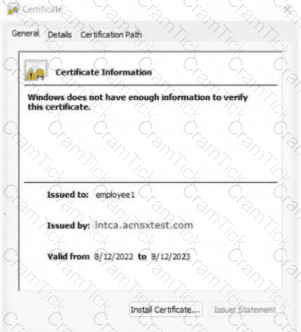
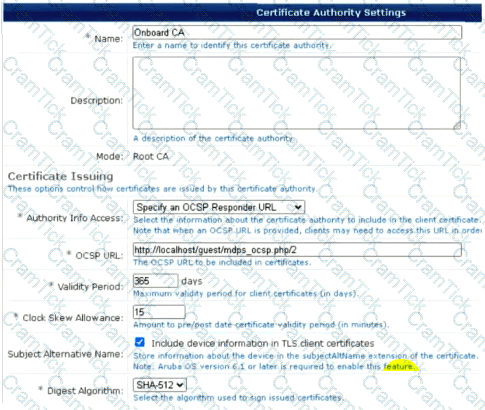
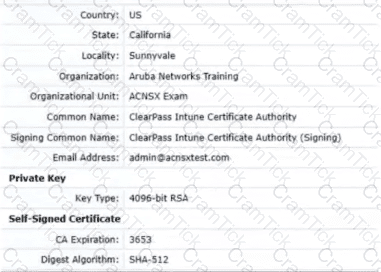
Which URL should you tell them to use?
This customer enforces 802.1X on AOS-CX switches using HPE Aruba Networking ClearPass Policy Manager (CPPM). The customer wants the switches to download role settings from CPPM. The reception-domain role must have these settings:
* Assign clients to VLAN 14 on switch 1, VLAN 24 on switch 2, and so on.
* Filter client traffic as follows:
* Clients are allowed full access to 10.1.5.0/24 and the Internet.
* Clients are denied access to 10.1.0.0/16.
Refer to the scenario.
Where should you configure rules that allow clients to access the appropriate IP addresses?
A customer operates two AOS-10 HPE Aruba Networking gateways at a site. The gateways are part of an SD-Branch solution managed by HPE Aruba Networking Central, and their cluster setting uses WLAN mode (the non-default gateway mode).
You are configuring a manual HPE Aruba Networking gateway cluster for dynamic authorization. The gateways have these IP addresses on a subnet that CPPM can access:
Gateway 1 = 10.56.20.2
Gateway 2 = 10.56.20.3
Which VRRP IP address assignments are valid for the gateways? Assume that all IP address options are available.
Refer to the scenario.
A customer uses an AOS-10 architecture managed by HPE Aruba Networking Central. HPE Aruba Networking infrastructure devices authenticate clients to an HPE Aruba Networking ClearPass cluster.
In HPE Aruba Networking Central, you are reviewing network traffic flows for a wireless IoT device categorized as a “Raspberry Pi” client. You observe SSH traffic. You then examine several additional wireless IoT clients and find that they are also sending SSH.
You want a relatively easy way to communicate to HPE Aruba Networking CPPM that an IoT client has used SSH.
What is one prerequisite?
You are configuring gateway IDS/IPS settings in HPE Aruba Networking Central.
Why would you set the Fail Strategy to Bypass?
When should BPDU protection be implemented on an AOS-CX switch port rather than BPDU filtering?




TESTED 21 Nov 2026