A Claude-based research assistant begins producing responses that confidently contradict its retrieved source documents despite no change to the retrieval pipeline.
Which two diagnostic actions most directly identify the root cause of this behavior? (Select two.)
You are building an evaluation pipeline for a Claude-based deployment and must complete the specification steps before running the deployment against the dataset.
Which two steps must be completed BEFORE running the deployment against the evaluation dataset? (Select two.)
Each correct answer presents part of the solution.
A technical team is debating whether to implement a new capability for generating regulatory filings from internal data as a Claude Skill or as an MCP server. The capability requires a fixed authoring procedure with embedded examples, does not need to call live external systems, and must be portable across three Claude deployments: claude.ai, an internal API integration, and Claude Code.
Which factor most strongly favors implementing the capability as a Skill?
You are integrating Claude Code into a workflow that runs against a production database.
Which guardrail design most directly preserves safety on data-modifying operations?
Engineering leadership wants to roll out Claude Skills to 280 developers across 14 teams. Skills will encode internal coding standards, code-review checklists, and incident-postmortem templates. Leadership has asked how to govern Skill authorship so that Skills remain trustworthy without bottlenecking on a single central team.
Which governance model should you recommend?
You are rolling out a standardized Claude Code configuration to an engineering team and must complete the planning steps before piloting the configuration.
Which two steps must be completed BEFORE piloting the configuration with a small group of engineers? (Select two.)
Each correct answer presents part of the solution.
You are supporting a team whose Claude Code sessions consistently load 60 or more MCP tools from many servers, exhausting context budget before the session begins.
Which adjustment most directly addresses this issue without removing capability?
A security team is evaluating two proposed controls. Control A adds an outbound tool allow-list with destination restrictions and per-call review. Control B scores responses against a stable adversarial evaluation set after each model-version change.
Which two risk categories are correctly matched to these controls? (Select two.)
A healthcare organization is evaluating two Claude-powered AI architectures for a clinical documentation assistant. Architecture X produces higher output quality scores but costs $0.18 per documentation session and averages 4.2 seconds per response. Architecture Y scores slightly lower on quality metrics but costs $0.09 per session and averages 2.1 seconds per response. The stated SLA requires responses under 3 seconds, and the annual volume is projected at 2 million documentation sessions.
Which evaluation approach correctly applies business value pillar analysis to this decision?
You are reviewing a peer’s draft system prompt that contains contradictory instructions: one section says never to speculate beyond the supplied source, while another says to confidently fill in any gaps.
Which response is most appropriate?
You are selecting a model for a new production workload and must complete the upstream steps before testing candidate models empirically.
Which two steps must be completed BEFORE running a representative sample on a candidate model? (Select two.)
Each correct answer presents part of the solution.
An operations engineer reports that a Claude-based pipeline began returning malformed JSON responses after a scheduled maintenance window, causing downstream processing failures.
Which two investigative steps most directly isolate the root cause? (Select two.)
You are responding to an adversarial input pattern in which users include text claiming admin authority and instructing the model to bypass safety restrictions.
Which combination of controls most effectively mitigates this attack pattern?
You are defining where human review must remain in a planned automated pipeline. Which placement reflects sound human-in-the-loop design?
After a prompt-template update, several previously passing test cases now produce unexpected outputs.
Which test type is specifically designed to detect this category of failure?
You are designing a feedback session for a deployment in flight.
Which structure best supports productive stakeholder feedback?
You are transitioning a Claude-based deployment from design into implementation.
Which handoff package most directly supports a clean transition?
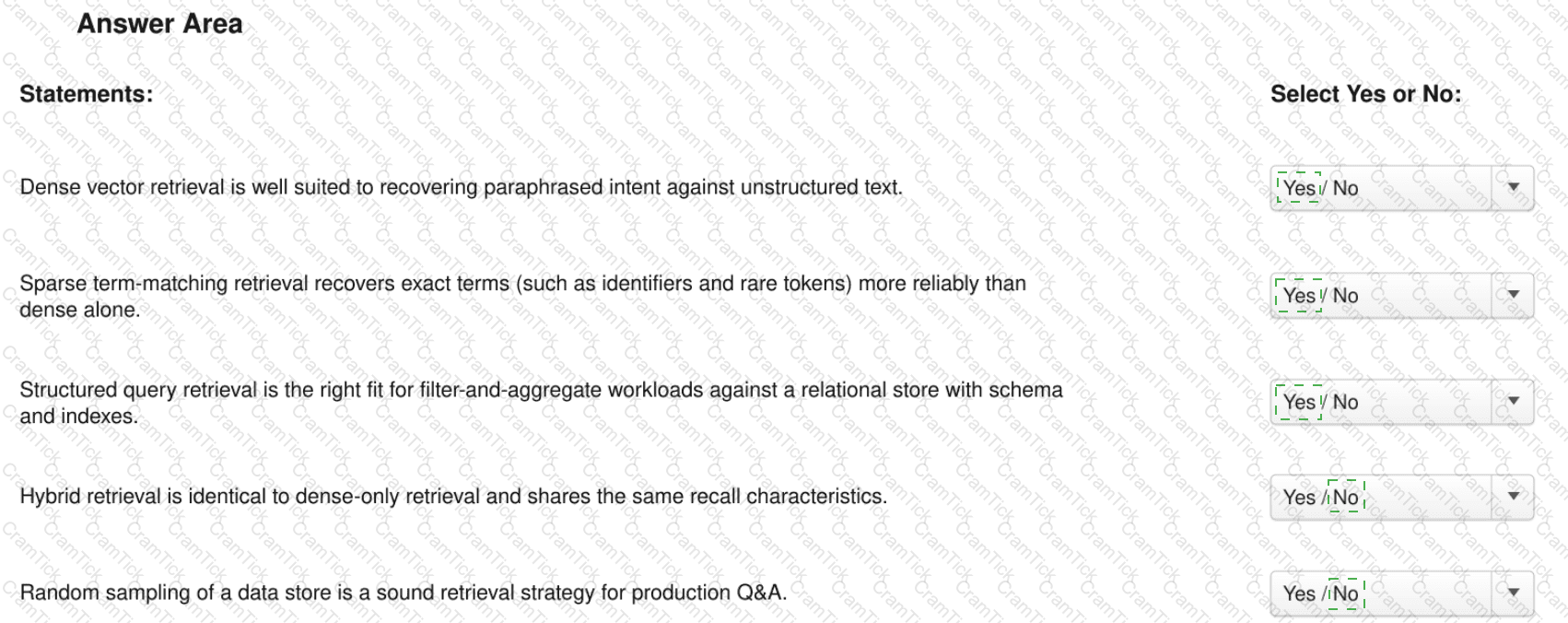
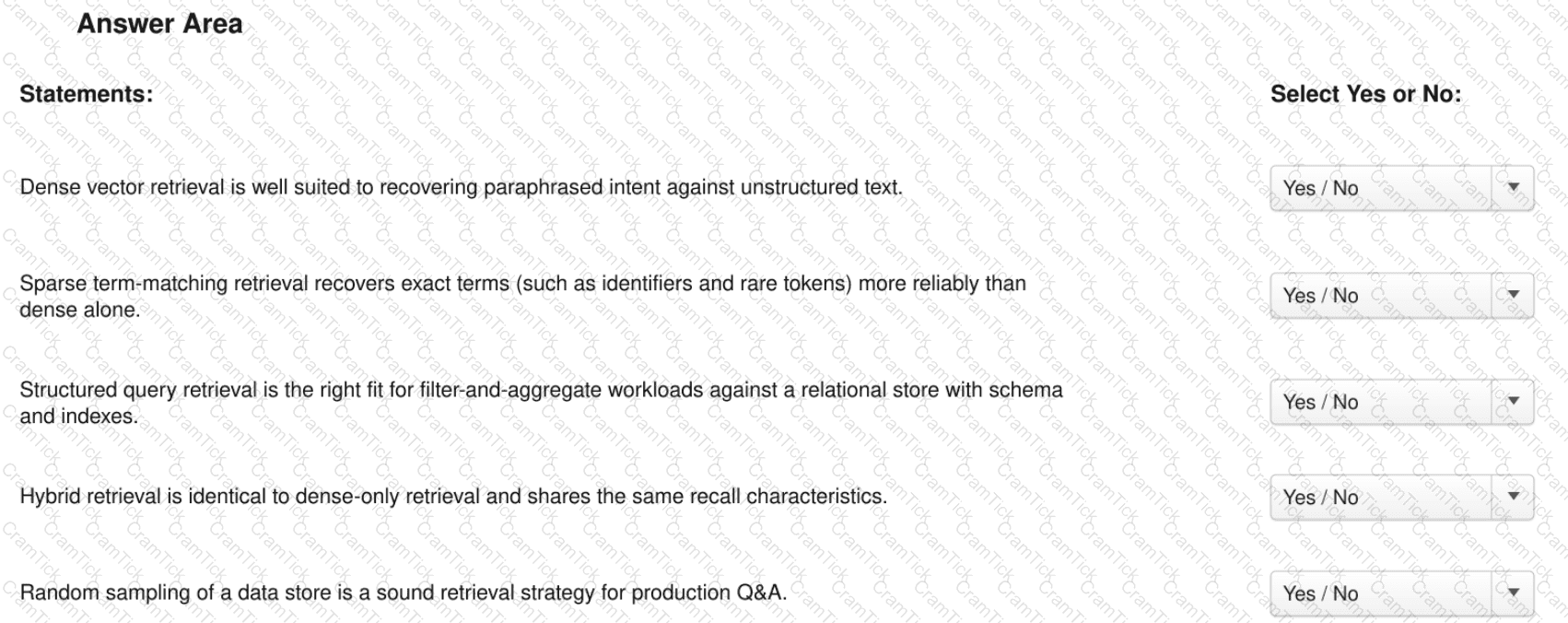
You are evaluating retrieval-strategy claims used by a peer team.
For each claim, select yes if the statement is generally accurate. Otherwise, select no.
You are comparing patterns for a batch document-classification job that follows fixed steps: extract metadata, classify, summarize, and persist.
Which pattern is the best fit and why?
You are compiling a diagnostic toolkit for Claude Code operational issues.
Which two diagnostic actions belong in the toolkit? (Select two.)
Each correct answer presents a complete solution.
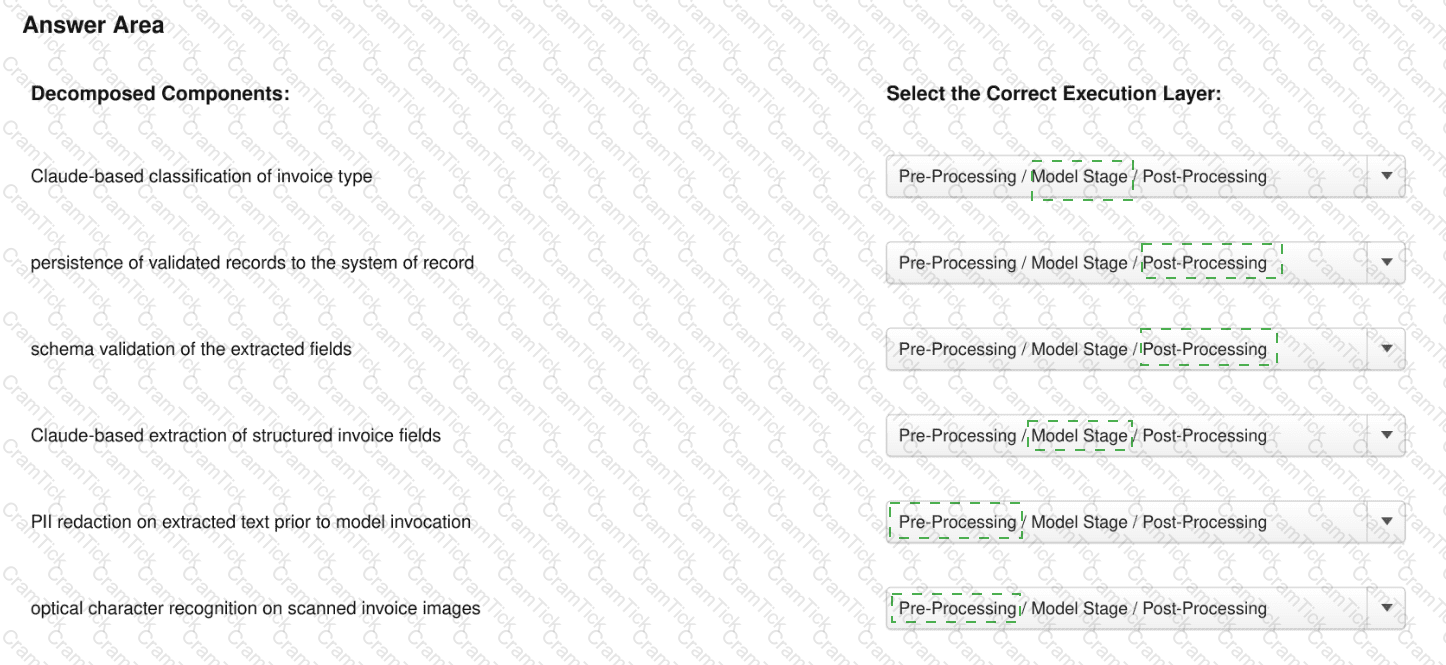
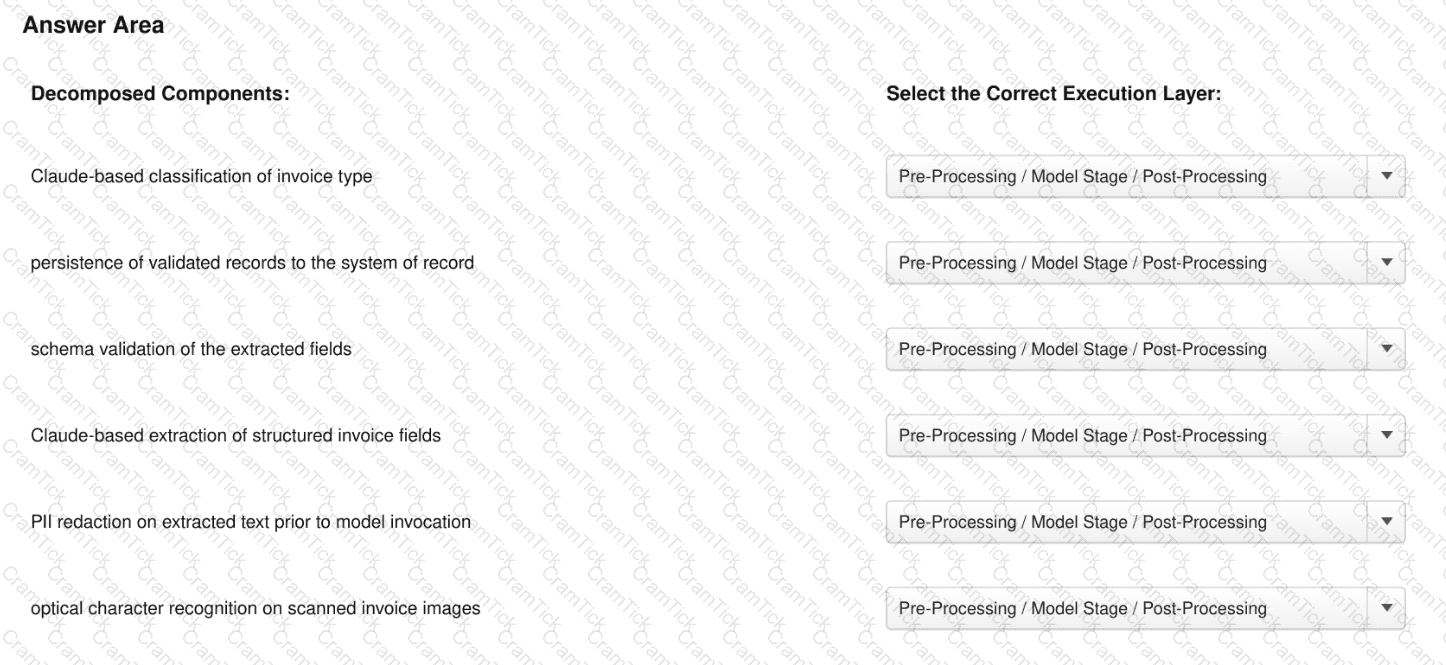
You are sequencing decomposed components in an invoice-processing pipeline.
For each of the decomposed components, select the execution layer it belongs to: “Pre-Processing,” “Model Stage,” or “Post-Processing.”
A document analysis service processes legal filings averaging 80,000 tokens each. Each filing is queried by attorneys an average of 14 times during a case. The current architecture sends the full filing on every query. The CFO has asked you to reduce per-query costs while preserving response quality. The security officer requires that filing contents not be stored outside Fabrikam ' s tenancy.
Which optimization approach should you recommend?
You are producing an architecture guide for a new deployment and must complete the planning steps before drafting each section.
Which two steps must be completed BEFORE drafting each section of the guide? (Select two.)
Each correct answer presents part of the solution.
You are responding to a stakeholder request that adds significant scope to a deployment already in flight.
Which response best aligns expectations while respecting the stakeholder’s underlying need?
You are designing a content moderation classifier that processes high volumes of user-generated comments under a tight per-message latency budget using well-defined classification labels.
Which model selection best aligns with the workload?
A Claude architect at a health services organization is defining evaluation metrics for a clinical-summary pipeline. The pipeline must remain within a per-query cost ceiling and must never surface patient data to unauthorized roles.
Which two metrics directly address these requirements? (Select two.)
You are configuring tool permissions for a Claude-based assistant. The assistant’s defined responsibilities require read access to a knowledge base and write access to a draft queue, and nothing else.
Which scoping design best applies least privilege?
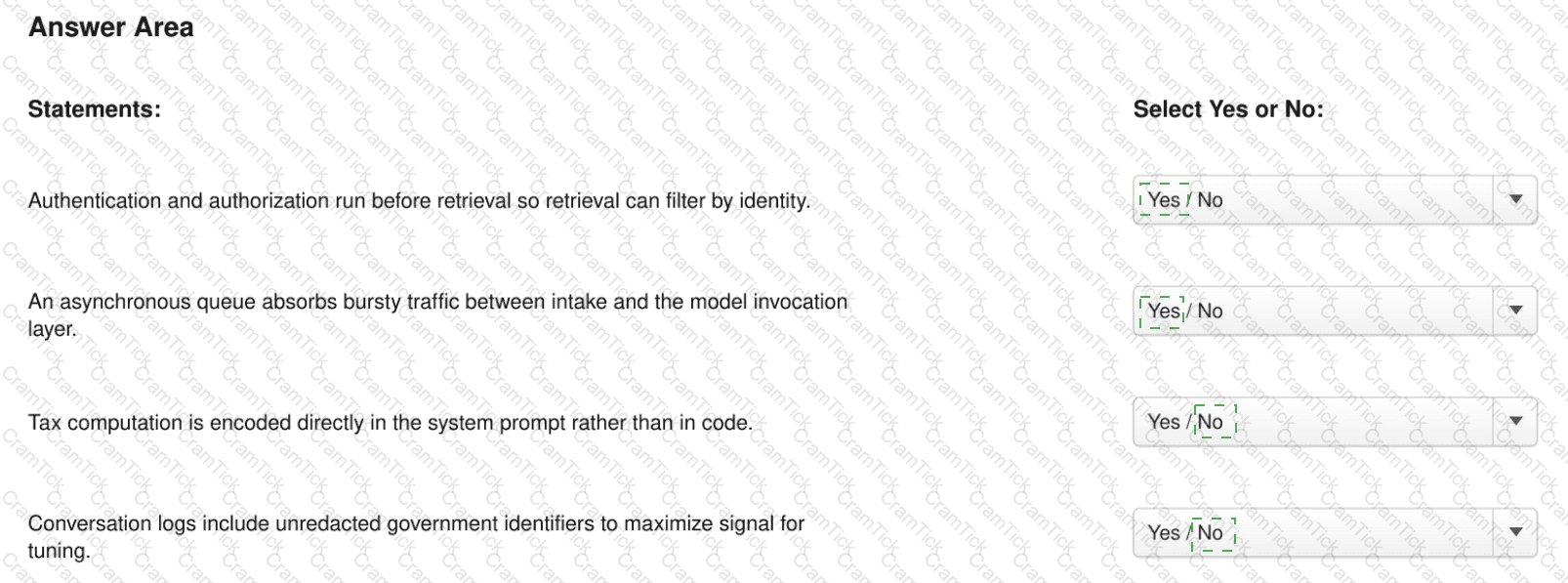
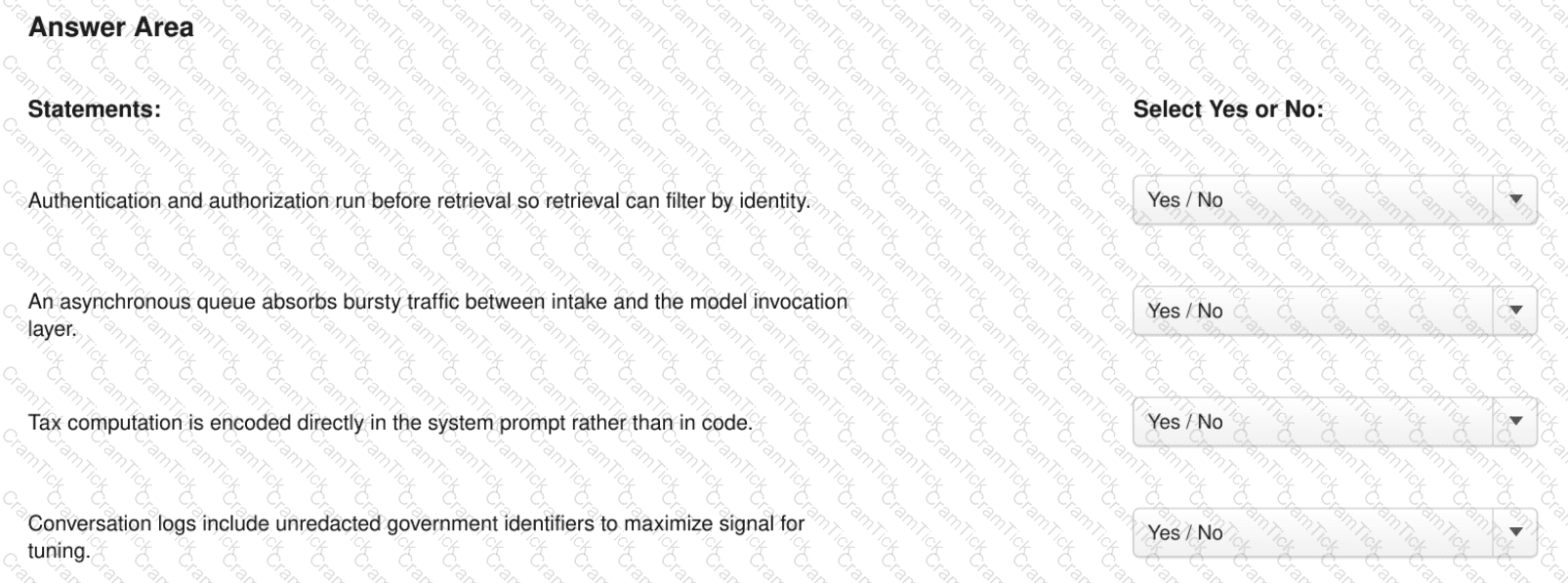
You are reviewing a peer’s end-to-end design for a Claude-based platform expected to scale to thousands of concurrent users.
For each statement, indicate Yes if it reflects sound architectural practice. Otherwise, select No.
During an architectural review, the security team identifies a risk that adversarial content injected into retrieved documents could manipulate the model’s behavior.
Which mitigation most directly addresses this threat?
You are selecting the documentation set that should accompany a Claude-based deployment at handoff. Which set is most complete?
You are comparing two configurations for an internal compliance Q & A assistant. Configuration X reduces top-k retrieval and uses a lighter model, lowering p95 latency by 38 percent while producing a measured 2 percent reduction in the accuracy benchmark. Configuration Y retains the existing top-k retrieval setting and heavier model, with unchanged p95 latency and no measurable change in accuracy. The deployment’s stated priorities are accuracy first and latency second.
Which configuration is the better recommendation?
A business sponsor has requested an AI solution to “improve customer experience.” The sponsor cannot articulate which customer journey is failing, which metric reflects the failure, or which decisions the AI should support. The sponsor is asking you to begin design work next week.
Which delegation-competency action should you take first?
You are defining an SLA for a Claude-based assistant.
Which SLA definition is most operationally meaningful?
A Claude architect is configuring a shared Claude Code environment for a twelve-person development team.
Which two configuration decisions most directly establish a consistent, secure team environment? (Select two.)
A revenue projection assistant has missed its monthly cost target by 38 percent. Profiling shows three contributors: a 6,000-token policy preamble repeated on every call (45 percent of cost), retrieval of historical sales chunks averaging 3,000 tokens per call (30 percent), and inference on a flagship-tier model (25 percent). Stakeholders require that projection accuracy remain unchanged.
Which two optimizations should you sequence first to reduce cost without affecting accuracy? (Select two.)
Each correct answer presents part of the solution.




TESTED 07 Oct 2026