An Organization has previously provisioned its own AWS VPC hosting various servers. The organization now needs to use Cloudhub to host a Mule application that will implement a REST API once deployed to Cloudhub, this Mule application must be able to communicate securely with the customer-provisioned AWS VPC resources within the same region, without being interceptable on the public internet.
What Anypoint Platform features should be used to meet these network communication requirements between Cloudhub and the existing customer-provisioned AWS VPC?
An organization is in the process of building automated deployments using a CI/CD process. As a part of automated deployments, it wants to apply policies to API Instances.
What tool can the organization use to promote and deploy API Manager policies?
Which Exchange asset type represents a complete API specification in RAML or OAS format?
Refer to the exhibit.
An organization is sizing an Anypoint VPC for the non-production deployments of those Mule applications that connect to the organization's on-premises systems. This applies to approx. 60 Mule applications. Each application is deployed to two CloudHub i workers. The organization currently has three non-production environments (DEV, SIT and UAT) that share this VPC. The AWS region of the VPC has two AZs.
The organization has a very mature DevOps approach which automatically progresses each application through all non-production environments before automatically deploying to production. This process results in several Mule application deployments per hour, using CloudHub's normal zero-downtime deployment feature.
What is a CIDR block for this VPC that results in the smallest usable private IP address range?
A company is using Mulesoft to develop API's and deploy them to Cloudhub and on premises targets. Recently it has decided to enable Runtime Fabric deployment option as well and infrastructure is set up for this option.
What can be used to deploy Runtime Fabric?
An organization is choosing between API-led connectivity and other integration approaches.
According to MuleSoft, which business benefits is associated with an API-led connectivity approach using Anypoint Platform?
An organization heeds to procure an enterprise software system to increase cross-selling opportunities and better rack prospect data.
Which category of enterprise software has these core capabilities, when used for its typical and intended purpose?
A high-volume eCommerce retailer receives thousands of orders per hour and requires notification of its order management, warehouse, and billing system for subsequent processing within 15 minutes of order submission through its website.
Which integration technology, when used for its typical and intended purpose, meets the retailer’s requirements for this use case?
An integration team follows MuleSoft’s recommended approach to full lifecycle API development.
Which activity should this team perform during the API implementation phase?
An auto mobile company want to share inventory updates with dealers Dl and D2 asynchronously and concurrently via queues Q1 and Q2. Dealer Dl must consume the message from the queue Q1 and dealer D2 to must consume a message from the queue Q2.
Dealer D1 has implemented a retry mechanism to reprocess the transaction in case of any errors while processing the inventers updates. Dealer D2 has not implemented any retry mechanism.
How should the dealers acknowledge the message to avoid message loss and minimize impact on the current implementation?
Refer to the exhibit.
A customer is running Mule applications on Runtime Fabric for Self-Managed Kubernetes
(RTF-BYOKS) in a multi-cloud environment.
Based on this configuration, how do Agents and Runtime Manager
communicate, and what Is exchanged between them?
A new Mule application has been deployed through Runtime Manager to CloudHub 1.0 using a CI/CD pipeline with sensitive properties set as cleartext. The Runtime Manager Administrator opened a high priority incident ticket about this violation of their security requirements indicating
these sensitive properties values must not be stored or visible in Runtime Manager but should be changeable in Runtime Manager by Administrators with proper permissions.
How can the Mule application be deployed while safely hiding the sensitive properties?
Refer to the exhibit.
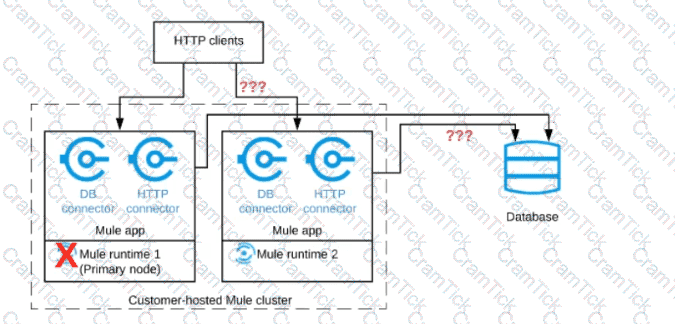
A Mule application is deployed to a cluster of two customer-hosted Mute runtimes. The Mute application has a flow that polls a database and another flow with an HTTP Listener.
HTTP clients send HTTP requests directly to individual cluster nodes.
What happens to database polling and HTTP request handling in the time after the primary (master) node of the cluster has railed, but before that node is restarted?
A company is implementing a new Mule application that supports a set of critical functions driven by a rest API enabled, claims payment rules engine hosted on oracle ERP. As designed the mule application requires many data transformation operations as it performs its batch processing logic.
The company wants to leverage and reuse as many of its existing java-based capabilities (classes, objects, data model etc.) as possible
What approach should be considered when implementing required data mappings and transformations between Mule application and Oracle ERP in the new Mule application?
What aspects of a CI/CD pipeline for Mule applications can be automated using MuleSoft-provided Maven plugins?
What Is a recommended practice when designing an integration Mule 4 application that reads a large XML payload as a stream?
A mule application must periodically process a large dataset which varies from 6 GB lo 8 GB from a back-end database and write transform data lo an FTPS server using a properly configured bad job scope.
The performance requirements of an application are approved to run in the cloud hub 0.2 vCore with 8 GB storage capacity and currency requirements are met.
How can the high rate of records be effectively managed in this application?
In a Mule Application, a flow contains two (2) JMS consume operations that are used to connect to a JMS broker and consume messages from two(2) JMS destination. The Mule application then joins the two JMS messages together.
The JMS broker does not implement high availability (HA) and periodically experiences scheduled outages of upto 10 mins for routine maintenance.
What is the most idiomatic (used for its intented purpose) way to build the mule flow so it can best recover from the expected outages?
During a planning session with the executive leadership, the development team director presents plans for a new API to expose the data in the company’s order database. An earlier effort to build an API on top of this data failed, so the director is recommending a design-first approach.
Which characteristics of a design-first approach will help make this API successful?
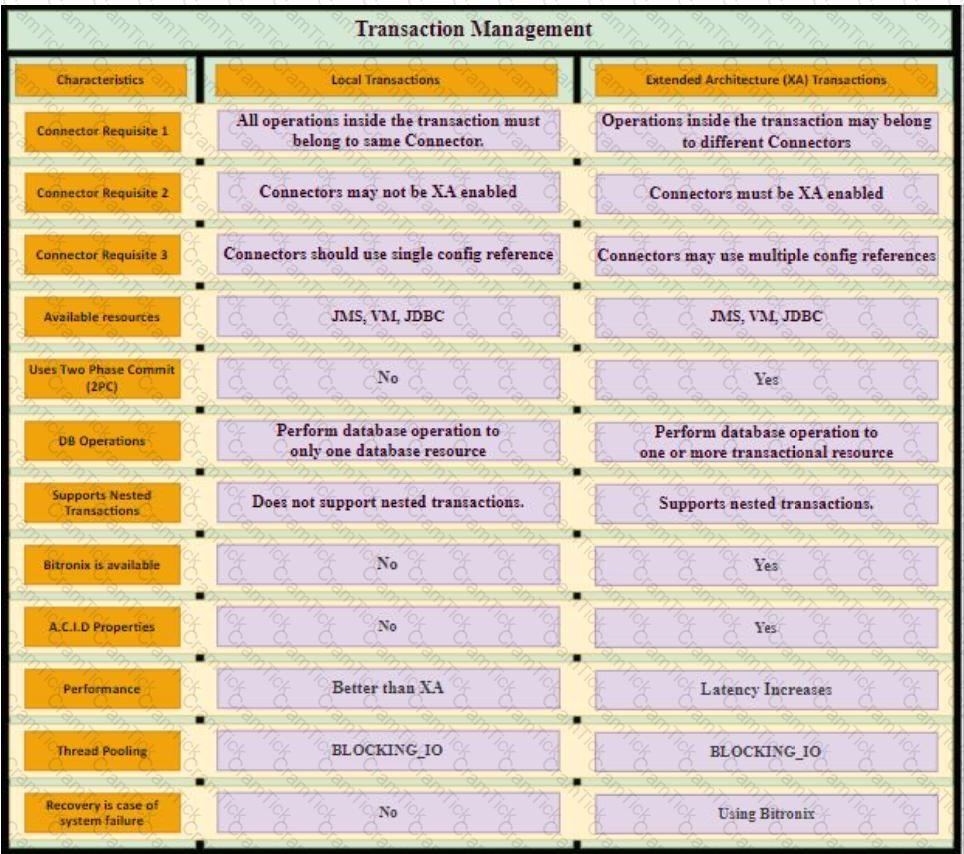
An XA transaction Is being configured that involves a JMS connector listening for Incoming JMS messages. What is the meaning of the timeout attribute of the XA transaction, and what happens after the timeout expires?
A leading bank implementing new mule API.
The purpose of API to fetch the customer account balances from the backend application and display them on the online platform the online banking platform. The online banking platform will send an array of accounts to Mule API get the account balances.
As a part of the processing the Mule API needs to insert the data into the database for auditing purposes and this process should not have any performance related implications on the account balance retrieval flow
How should this requirement be implemented to achieve better throughput?
A manufacturing company is planning to deploy Mule applications to its own Azure Kubernetes Service infrastructure.
The organization wants to make the Mule applications more available and robust by deploying each Mule application to an isolated Mule runtime in a Docker container while managing all the Mule applications from the MuleSoft-hosted control plane.
What is the most idiomatic (used for its intended purpose) choice of runtime plane to meet these organizational requirements?
A mule application is required to periodically process large data set from a back-end database to Salesforce CRM using batch job scope configured properly process the higher rate of records.
The application is deployed to two cloudhub workers with no persistence queues enabled.
What is the consequence if the worker crashes during records processing?
A project team uses RAML specifications to document API functional requirements and deliver API definitions. As per the current legal requirement, all designed API definitions to be augmented with an additional non-functional requirement to protect the services from a high rate of requests according to define service level agreements.
Assuming that the project is following Mulesoft API governance and policies, how should the project team convey the necessary non-functional requirement to stakeholders?
The implementation of a Process API must change. What is a valid approach that minimizes the impact of this change on API clients?
A set of integration Mule applications, some of which expose APIs, are being created to enable a new business process. Various stakeholders may be impacted by this. These stakeholders are a combination of semi-technical users (who understand basic integration terminology and concepts such as JSON and XML) and technically skilled potential consumers of the Mule applications and APIs.
What Is an effective way for the project team responsible for the Mule applications and APIs being built to communicate with these stakeholders using Anypoint Platform and its supplied toolset?
A travel company wants to publish a well-defined booking service API to be shared with its business partners. These business partners have agreed to ONLY consume SOAP services and they want to get the service contracts in an easily consumable way before they start any development. The travel company will publish the initial design documents to Anypoint Exchange, then share those documents with the business partners. When using an API-led approach, what is the first design document the travel company should deliver to its business partners?
A developer is examining the responses from a RESTful web service that is compliant with the Mypertext Transfer Protocol (HTTP/1.1) a8 defined by the Internet Engineering Task Force (IETF).
In this HTTP/1.1-compliant web service, which class of HTTP response status codes should be specified to indicate when client requests are successfully received, understood, and accepted by the web service?
The AnyAirline organization's passenger reservations center is designing an integration solution that combines invocations of three different System APIs (bookFlight, bookHotel, and bookCar) in a business transaction. Each System API makes calls to a single database.
The entire business transaction must be rolled back when at least one of the APIs fails.
What is the most idiomatic (used for its intended purpose) way to integrate these APIs in near real-time that provides the best balance of consistency, performance, and reliability?
What is an advantage that Anypoint Platform offers by providing universal API management and Integration-Platform-as-a-Service (iPaaS) capabilities in a unified platform?
An automation engineer needs to write scripts to automate the steps of the API lifecycle, including steps to create, publish, deploy and manage APIs and their implementations in Anypoint Platform.
What Anypoint Platform feature can be used to automate the execution of all these actions in scripts in the easiest way without needing to directly invoke the Anypoint Platform REST APIs?
Which Exchange asset type represents configuration modules that extend the functionality of an API and enforce capabilities such as security?
An organization is designing a mule application to support an all or nothing transaction between serval database operations and some other connectors so that they all roll back if there is a problem with any of the connectors
Besides the database connector , what other connector can be used in the transaction.
A Kubernetes controller automatically adds another pod replica to the resource pool in response to increased application load.
Which scalability option is the controller implementing?
An organization is designing the following two Mule applications that must share data via a common persistent object store instance:
- Mule application P will be deployed within their on-premises datacenter.
- Mule application C will run on CloudHub in an Anypoint VPC.
The object store implementation used by CloudHub is the Anypoint Object Store v2 (OSv2).
what type of object store(s) should be used, and what design gives both Mule applications access to the same object store instance?
What operation can be performed through a JMX agent enabled in a Mule application?
When designing an upstream API and its implementation, the development team has been advised to not set timeouts when invoking downstream API. Because the downstream API has no SLA that can be relied upon. This is the only donwstream API dependency of that upstream API. Assume the downstream API runs uninterrupted without crashing. What is the impact of this advice?
As a part of design , Mule application is required call the Google Maps API to perform a distance computation. The application is deployed to cloudhub.
At the minimum what should be configured in the TLS context of the HTTP request configuration to meet these requirements?
An organization has just developed a Mule application that implements a REST API. The mule application will be deployed to a cluster of customer hosted Mule runtimes.
What additional infrastructure component must the customer provide in order to distribute inbound API requests across the Mule runtimes of the cluster?
A banking company is developing a new set of APIs for its online business. One of the critical API's is a master lookup API which is a system API. This master lookup API uses persistent object store. This API will be used by all other APIs to provide master lookup data.
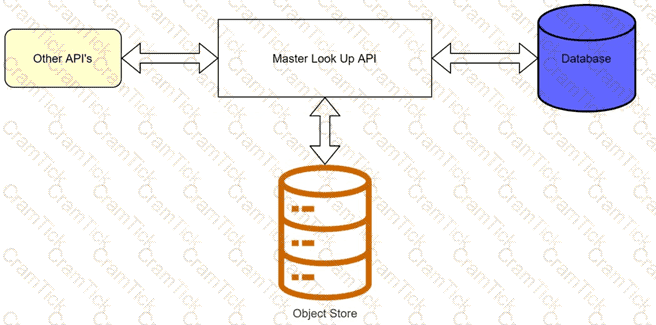
Master lookup API is deployed on two cloudhub workers of 0.1 vCore each because there is a lot of master data to be cached. Master lookup data is stored as a key value pair. The cache gets refreshed if they key is not found in the cache.
Doing performance testing it was observed that the Master lookup API has a higher response time due to database queries execution to fetch the master lookup data.
Due to this performance issue, go-live of the online business is on hold which could cause potential financial loss to Bank.
As an integration architect, which of the below option you would suggest to resolve performance issue?
Which role is primarily responsible for building API implementation as part of a typical MuleSoft integration project?
A large life sciences customer plans to use the Mule Tracing module with the Mapped Diagnostic Context (MDC) logging operations to enrich logging in its Mule application and to improve tracking by providing more context in the Mule application logs. The customer also wants to improve throughput and lower the message processing latency in its Mule application flows.
After installing the Mule Tracing module in the Mule application, how should logging be performed in flows in Mule applications, and what should be changed In the log4j2.xml files?
An organization is designing a Mule application to periodically poll an SFTP location for new files containing sales order records and then process those sales orders. Each sales order must be processed exactly once.
To support this requirement, the Mule application must identify and filter duplicate sales orders on the basis of a unique ID contained in each sales order record and then only send the new sales orders to the downstream system.
What is the most idiomatic (used for its intended purpose) Anypoint connector, validator, or scope that can be configured in the Mule application to filter duplicate sales orders on the basis of the unique ID field contained in each sales order record?
Refer to the exhibit.
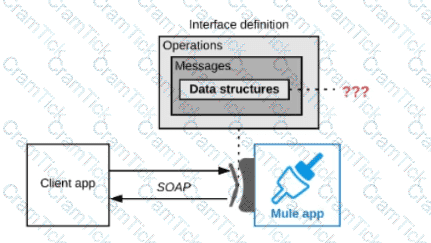
A Mule application is being designed to expose a SOAP web service to its clients.
What language is typically used inside the web service's interface definition to define the data structures that the web service Is expected to exchange with its clients?
An IT integration tram followed an API-led connectivity approach to implement an order-fulfillment business process. It created an order processing AP that coordinates stateful interactions with a variety of microservices that validate, create, and fulfill new product orders
Which interaction composition pattern did the integration architect who designed this order processing AP| use?
In which order are the API Client, API Implementation, and API interface components called in a typical REST request?
A company is planning to migrate its deployment environment from on-premises cluster to a Runtime Fabric (RTF) cluster. It also has a requirement to enable Mule applications deployed to a Mule runtime instance to store and share data across application replicas and restarts.
How can these requirements be met?
According to MuleSoft's API development best practices, which type of API development approach starts with writing and approving an API contract?
When using Anypoint Platform across various lines of business with their own Anypoint Platform business groups, what configuration of Anypoint Platform is always performed at the organization level as opposed to at the business group level?
A Mule application is deployed to a cluster of two(2) cusomter-hosted Mule runtimes. Currently the node name Alice is the primary node and node named bob is the secondary node. The mule application has a flow that polls a directory on a file system for new files.
The primary node Alice fails for an hour and then restarted.
After the Alice node completely restarts, from what node are the files polled, and what node is now the primary node for the cluster?
An organization uses a four(4) node customer hosted Mule runtime cluster to host one(1) stateless api implementation. The API is accessed over HTTPS through a load balancer that uses round-robin for load distribution. Each node in the cluster has been sized to be able to accept four(4) times the current number of requests.
Two(2) nodes in the cluster experience a power outage and are no longer available. The load balancer directs the outage and blocks the two unavailable the nodes from receiving further HTTP requests.
What performance-related consequence is guaranteed to happen to average, assuming the remaining cluster nodes are fully operational?
Refer to the exhibit.
An organization is designing a Mule application to receive data from one external business partner. The two companies currently have no shared IT infrastructure and do not want to establish one. Instead, all communication should be over the public internet (with no VPN).
What Anypoint Connector can be used in the organization's Mule application to securely receive data from this external business partner?
To implement predictive maintenance on its machinery equipment, ACME Tractors has installed thousands of IoT sensors that will send data for each machinery asset as sequences of JMS messages, in near real-time, to a JMS queue named SENSOR_DATA on a JMS server. The Mule application contains a JMS Listener operation configured to receive incoming messages from the JMS servers SENSOR_DATA JMS queue. The Mule application persists each received JMS message, then sends a transformed version of the corresponding Mule event to the machinery equipment back-end systems.
The Mule application will be deployed to a multi-node, customer-hosted Mule runtime cluster. Under normal conditions, each JMS message should be processed exactly once.
How should the JMS Listener be configured to maximize performance and concurrent message processing of the JMS queue?
An integration Mule application is deployed to a customer-hosted multi-node Mule 4 runtime duster. The Mule application uses a Listener operation of a JMS connector to receive incoming messages from a JMS queue.
How are the messages consumed by the Mule application?
A mule application is being designed to perform product orchestration. The Mule application needs to join together the responses from an inventory API and a Product Sales History API with the least latency.
To minimize the overall latency. What is the most idiomatic (used for its intended purpose) design to call each API request in the Mule application?
A company is designing a mule application to consume batch data from a partner's ftps server The data files have been compressed and then digitally signed using PGP.
What inputs are required for the application to securely consumed these files?
According to the National Institute of Standards and Technology (NIST), which cloud computing deployment model describes a composition of two or more distinct clouds that support data and application portability?
An organization is successfully using API led connectivity, however, as the application network grows, all the manually performed tasks to publish share and discover, register, apply policies to, and deploy an API are becoming repetitive pictures driving the organization to automate this process using efficient CI/'CD pipeline. Considering Anypoint platforms capabilities how should the organization approach automating is API lifecycle?
According to MuleSoft, a synchronous invocation of a RESTful API using HTTP to get an individual customer record from a single system is an example of which system integration interaction pattern?
What aspect of logging is only possible for Mule applications deployed to customer-hosted Mule runtimes, but NOT for Mule applications deployed to CloudHub?
What comparison is true about a CloudHub Dedicated Load Balancer (DLB) vs. the CloudHub Shared Load Balancer (SLB)?
An ABC Farms project team is planning to build a new API that is required to work with data from different domains across the organization.
The organization has a policy that all project teams should leverage existing investments by reusing existing APIs and related resources and documentation that other project teams have already developed and deployed.
To support reuse, where on Anypoint Platform should the project team go to discover and read existing APIs, discover related resources and documentation, and interact with mocked versions of those APIs?
A retail company is implementing a MuleSoft API to get inventory details from two vendors by Invoking each vendor's online applications. Due to network issues, the invocations to the vendor applications are timing out intermittently, but the requests are successful after re-invoking each
vendor application.
What is the most performant way of implementing the API to invoke each vendor application and to retry invocations that generate timeout errors?
In one of the critical payment related mule application, transaction is being used . As an enhancement to implementation , scatter gather route is introduced which is also the part of transaction group. Scatter gather route has 4 routes.
What will be the behavior of the Mule application in case of error occurs in 4th route of the scatter-gather router and transaction needs to be rolled back?
As a part of project requirement, client will send a stream of data to mule application. Payload size can vary between 10mb to 5GB. Mule application is required to transform the data and send across multiple sftp servers. Due to the cost cuttings in the organization, mule application can only be allocated one worker with size of 0.2 vCore.
As an integration architect , which streaming strategy you would suggest to handle this scenario?
How are the API implementation , API client, and API consumer combined to invoke and process an API ?
An organization plans to extend its Mule APIs to the EU (Frankfurt) region.
Currently, all Mule applications are deployed to CloudHub 1.0 in the default North American region, from the North America control plane, following this naming convention: {API-name}—{environment} (for example, Orderssapi—dev, Orders-sapi-—qa, Orders-sapi-—prod, etc.).
There is no network restriction to block communications between APIs.
What strategy should be implemented in order to deploy the same Mule APIs to the CloudHub 1.0 EU region from the North America control plane,
as well as to minimize latency between APIs and target users and systems in Europe?
An organization is designing an integration solution to replicate financial transaction data from a legacy system into a data warehouse (DWH).
The DWH must contain a daily snapshot of financial transactions, to be delivered as a CSV file. Daily transaction volume exceeds tens of millions of records, with significant spikes in volume during popular shopping periods.
What is the most appropriate integration style for an integration solution that meets the organization's current requirements?
Customer has deployed mule applications to different customer hosted mule run times. Mule applications are managed from Anypoint platform.
What needs to be configured to monitor these Mule applications from Anypoint monitoring and what sends monitoring data to Anypoint monitoring?
Which productivity advantage does Anypoint Platform have to both implement and manage an AP?
An API has been updated in Anypoint Exchange by its API producer from version 3.1.1 to 3.2.0 following accepted semantic versioning practices and the changes have been communicated via the API's public portal. The API endpoint does NOT change in the new version. How should the developer of an API client respond to this change?
An organization has deployed runtime fabric on an eight note cluster with performance profile. An API uses and non persistent object store for maintaining some of its state data. What will be the impact to the stale data if server crashes?
An organization's governance process requires project teams to get formal approval from all key stakeholders for all new Integration design specifications. An integration Mule application Is being designed that interacts with various backend systems. The Mule application will be created using Anypoint Design Center or Anypoint Studio and will then be deployed to a customer-hosted runtime.
What key elements should be included in the integration design specification when requesting approval for this Mule application?
An integration Mute application consumes and processes a list of rows from a CSV file. Each row must be read from the CSV file, validated, and the row data sent to a JMS queue, in the exact order as in the CSV file.
If any processing step for a row falls, then a log entry must be written for that row, but processing of other rows must not be affected.
What combination of Mute components is most idiomatic (used according to their intended purpose) when Implementing the above requirements?




TESTED 05 Oct 2026

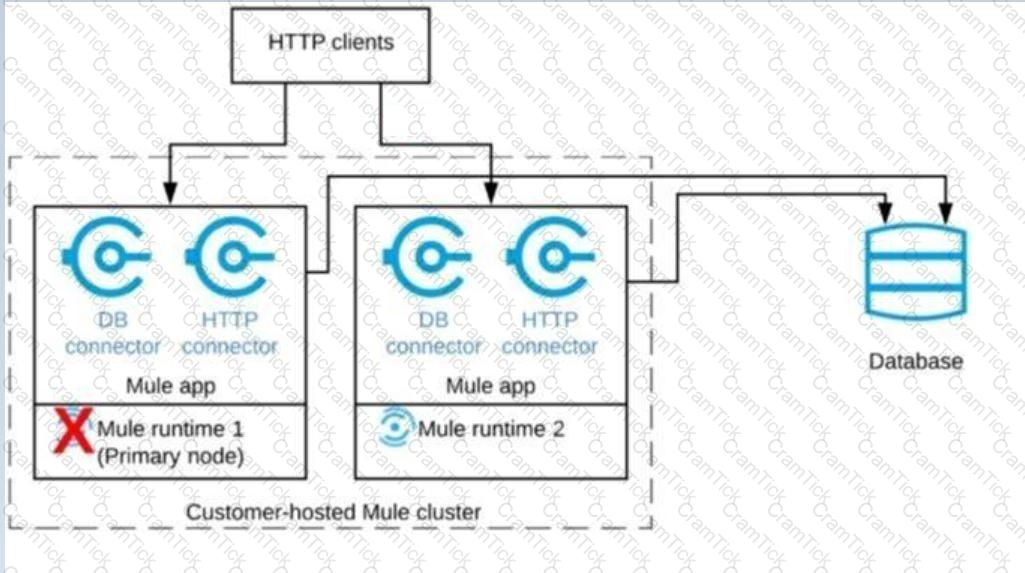 Diagram Description automatically generated
 Graphical user interface, table Description automatically generated with medium confidence
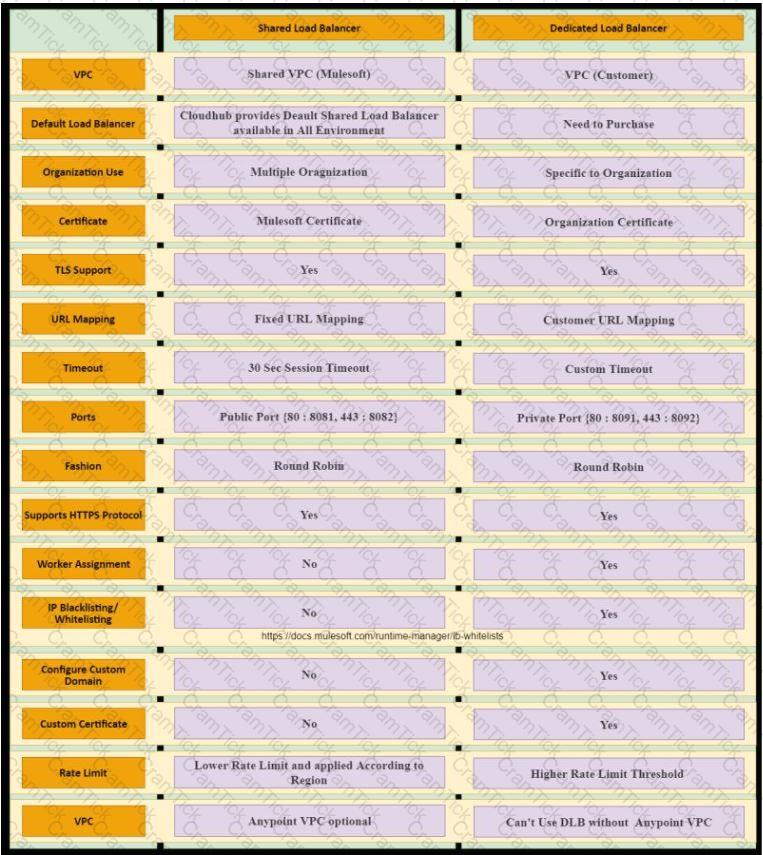 Table Description automatically generated
 Graphical user interface Description automatically generated