A global cosmetics company surveys consumers. The survey reveals close to 75% of consumers indicate sustainability is an important issue and are willing to change shopping habits to reduce environmental impact. The company responds by establishing a sustainability framework. As part of the process to implement this framework, a company sustainability analyst identifies sustainable investment and disclosure practices.
Which recommendation will the analyst likely make to implement a company sustainability framework?
A national regulator develops a new taxonomy for environmentally sustainable activities and policies. The taxonomy will provide clarity for companies, capital markets, and policymakers on sustainable activities. During the development process, regulators survey taxonomies used across various jurisdictions and decide to model after the EU Taxonomy.
Which characteristic of the EU Taxonomy will the regulator most likely implement in the new taxonomy?
A telecommunications corporation issues a green bond to finance energy efficiency improvements for the company’s office space worldwide. The company’s risk management department commissions an independent advisory assessment of the bond to check bond alignment with components of the Green Bond Principles.
What action does the corporation take to align the bond with the “process for project evaluation and selection” component of the Green Bond Principles?
A timber products company in the southeastern US plants, manages, and harvests a species of trees with a 30-year growth cycle. Prior to a planting cycle, the risk management team measures company exposure to stranded asset risk. Which of the following will the team most likely use to measure stranded asset exposure risk to the company?
Senior officials in the environmental ministry of a South American country prepare a briefing for a new minister. The minister questions the usefulness of large international conferences to achieve real progress in GHG reduction. The briefing focuses on COP21 in Paris, which ended with an agreement to address climate change. Which of the following Paris Agreement achievements did the officials most likely note in the briefing?
A diversified industrial company embarks on a climate transition strategy to invest in a more fuel-efficient airline fleet. To finance the investment, the CSO analyzes sustainable finance instruments and recommends instruments most suitable to issue.
Which of the following financial instruments should the CSO recommend and why?
To assess potential business implications of climate change, a large manufacturing company implements scenario analysis for the first time. The company hires a consultant to help incorporate climate-related considerations into a model of the company’s potential business outcomes.
What useful scenario analysis information should the consultant make the company aware of?
A sustainability analyst at a global energy company assesses trends in the electric power sector for the next 10 years. To inform strategy, the analyst focuses on the interaction among climate risks, advancements in renewable energy, and stranded asset risk for fossil fuels.
According to the analyst, what trend will likely emerge during the next decade?
A major hurricane extensively damages the electrical infrastructure of a utility company. To improve the utility’s risk management, the risk director prepares a strategy plan and incorporates climate risk considerations within the existing risk management framework.
Which recommendation should the director make to incorporate climate risk into the framework’s risk identification component?
As climate change poses new financial risks to a central bank’s monetary policy operations, the bank decides to adapt operations with NGFS guidelines. Because the central bank does not include climate change in supervision practices, the bank consults subject matter experts (SMEs) to develop a proposal for central bank action on climate change. After completing the risk assessment, SMEs recommend the bank incorporate microprudential and macroprudential measures to embed climate change into supervision practices.
Which action are SMEs likely to recommend?
To comply with publicly stated climate goals, a country dependent on fossil fuel production begins phasing out oil production facilities. Climate activists largely celebrate this commitment, while expressing concern for a just transition. Which of the following just transition programs will the activists most likely support?
The climate risk team at a global bank works on a sustainability and climate risk report for a forthcoming company strategy meeting. The meeting will focus on bank goals to achieve net zero GHG emissions by 2050. Bank leaders will discuss potential risk exposures the bank may face, as well as possible financial systemic effects.
Which of the following is an example of how systemic climate risk can translate into liquidity risk for the bank?
Alimento Y Agricultura (AYA) is a food and agriculture conglomerate headquartered in Costa Rica with operations throughout Central America. AYA historically produced coffee, bananas, and sugar. Over the last decade, the company growing region experienced climate-related crop production challenges. The region suffered prolonged drought conditions and severe flooding events. AYA leadership may relocate existing coffee farm locations in response to these climate stressors.
Last year Costa Rica introduced mandatory climate risk reporting aligned with ISSB standards The government mandate compelled AYA to enhance its transition and physical risk assessment across the company. A newly formed sustainability governance team prioritizes the following objectives:
• Update TCFD reporting with new ISSB IFRS S2 requirements
• Initiate more comprehensive scenario analysis
• Conduct nature and water risk assessments
AYA previously reported climate risks aligned with all TCFD pillars, risk categories, and scenario analysis recommendations. Reporting includes all Scope 1 and Scope 2 emissions, reduction targets, and appointments of board officers responsible for climate risks. Scenario analysis is used to assess all banana, coffee, and sugar production climate risk exposure.
AYA uses 2°C and 4°C climate scenarios to assess company impacts from physical and transition risk. Under the 2°C scenario transition risk increases, while under the 4°C scenario water risk significantly increases.
AYA appoints an SCR certificate holder to the position of nature risk manager to advance nature-based assessments. The manager contracts with a nature risk consultancy to better understand and manage exposure to nature-related risks and impacts. The consultancy identifies crop production, water quality, and water quantity as the primary nature-based risks.
The consultancy produces the following graph to demonstrate coffee crop productivity:
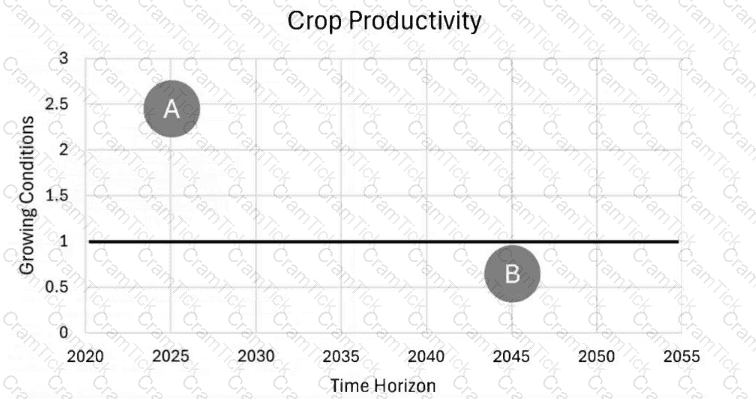
If growing conditions fall below 1, it is not economical for AYA to continue coffee production in the region. Point A indicates current growing conditions. Point B is a forecast of future conditions under a 4°C scenario, created by the consultancy model.
After identifying nature risks broadly, AYA performs a water risk assessment (WRA). The WRA assesses historical and future water withdrawal rates and identifies operational water dependencies.
Following the WRA, the company engages with existing stakeholders to adapt existing business strategy. AYA initiates a pilot project with upstream farmers to protect their land. AYA will either train or pay local farmers to plant shrubbery and buffer zones to reduce erosion and runoff of sediments, nutrients, and pathogens from local crop production and industry.
Which LEAP concept best describes Point A in the context of coffee growing conditions?
Senior management of a sportswear manufacturer will issue a bond to optimize company capital structure, while providing investors with an opportunity to contribute to positive transformation of the fashion industry. Management prefers a bond with a high rate of issuance, and the company sustainability team researches various green and sustainable finance instruments and issuance information over the past 5 years. The team recommends a bond that globally posted the highest growth in issuance between 2019 and 2020.
Which bond did the team recommend?
Which of the following greenhouse gases (GHGs) has the longest lifetime in the atmosphere?
A risk manager at a fertilizer production company prepares a GHG emissions report on company product usage, emissions, and energy sources. The manager notes the company adequately tracks and proactively manages carbon emissions. However, the manager identifies several non-carbon emitting activities that can affect the climate through radiative forcing. Which of the following positive radiative forcing drivers will the manager most likely identify?
An international report on SDG progress identifies a large south Asian nation as not on track to meet most SDGs. Specifically, the nation’s reduction of infant mortality and adoption of clean energy lag behind regional peers. In response, a government environmental minister creates a memorandum outlining steps the nation can take to advance the 2030 Agenda goals. The office distributes the memorandum to other government agencies.
How will the memorandum describe the 2030 Agenda goals?
Which of the following is an example of a just’ transition with regards to climate change?
A large country joins the Paris Agreement and directs the national environmental department to disseminate new policies and goals to relevant federal agencies. Most agencies are familiar with past climate agreement principles and protocols but not those of the Paris Agreement.
The environmental department should educate federal agencies on what feature of the Paris Agreement?
A global logistics company evaluates how climate change could disrupt its global distribution network. The CSO recommends a scenario analysis exercise to explore long-term risks and opportunities. Which of the following variables should the company include to effectively develop climate scenarios?
A climate resilience consultant prepares an overview for a regional agency client. The overview summarizes climate policies that significantly reduce emissions. The client expresses a strong preference for a policy that limits emissions and offers flexibility in participant permits.
What policy should the consultant recommend to the client?
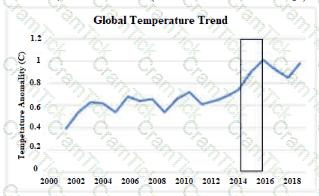
A scientist at a large agricultural company develops an internal presentation that explains weather variation and long-term climate change. The scientist presents global annual temperature anomalies (relative to a 1951-1980 average) throughout the last 20 years:
What natural forcing contributed to the temperature trend from 2014 to 2016?
An industry association in Germany surveys members on business alignment with nationally determined contributions (NDCs). The association members express concern about potential cascading legal repercussions or penalties if governments do not conform to Paris Agreement pledges. An attorney at the association researches this issue and sends a memo to members.
The memo should state the Paris Agreement legally obliges signatories to take what action?
An investment analyst assesses climate-related stranded asset risk for a portfolio of energy companies. The analyst develops a list of companies potentially exhibiting stranded asset risk. After a more granular examination, the analyst summarizes corporate activity in the following table:
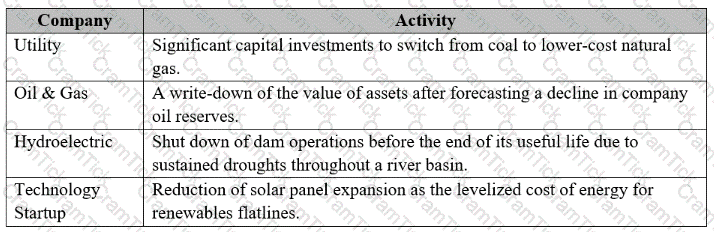
The analyst identifies the company with the highest stranded asset exposure for possible divestment. Which company does the analyst recommend for divestment?
A technology company expands its sustainable offerings and develops a flight booking application that allows customers to offset a flight’s carbon emissions. An analyst at the company researches climate agreements to inform the structure of the offsetting program.
How does the analyst describe the achievements and shortcomings of the agreements?
A solar panel manufacturing company for renewable energy systems makes a 2040 net-zero commitment. The company sustainability director references the COSO ERM framework to inform the company’s long-term growth strategy. Which approach will the director most likely use to effectively assess the impact of transition risk on the business strategy?
A senior advisor from a government agency in Southeast Asia proposes a national framework to classify sustainable economic activities, aligned with the EU Taxonomy. The new framework will limit environmental harm and promote sustainable growth. Which EU Taxonomy requirement will the advisor most likely incorporate into the proposed framework?
To achieve emissions reduction goals, a South American government considers policies other than carbon pricing to target carbon-intensive industries more effectively. The government intends to promote renewable power generation by implementing subsidies.
Which action should the government take to support this subsidy policy?
A recent sustainability report revealed the pension fund of a small European nation is heavily invested in sectors with poor sustainability records. In response to pensioner and other stakeholder requests, the fund joins the PRI.
What strategy must the fund incorporate to comply with the PRI?
After recent summer and winter temperature extremes disrupt operations, a national oil company evaluates its 10-year business plan. The risk department reviews how corporate assets, both physical and human, are resilient to climate change. Early in the planning process, a risk team member emphasizes the importance of planning for both acute and chronic climate hazards.
How should the team member describe acute and chronic hazards in terms of the 10-year strategy?
After recent summer and winter temperature extremes disrupt operations, a national oil company evaluates its 10-year business plan. The risk department reviews how corporate assets, both physical and human, are resilient to climate change. Early in the planning process, a risk team member emphasizes the importance of planning for both acute and chronic climate hazards.
How should the team member describe acute and chronic hazards in terms of the 10-year strategy?
In response to policy and technology changes, a cement manufacturer looks for new opportunities to raise profits by reducing GHG emissions. Because the cement industry accounts for a considerable percentage of global emissions, the manufacturer joins a coalition of company peers. The coalition lobbies country governments to adhere to the Paris Agreement nationally determined contributions (NDCs).
Which of the following actions does the coalition recommend?

TESTED 03 Oct 2026