You are configuring a monthly schedule for an EIB integration that runs on the last day of each month.
What is the maximum end date you can use in this configuration?
Refer to the following XML to answer the question below.
Refer to the following XML to answer the question below.
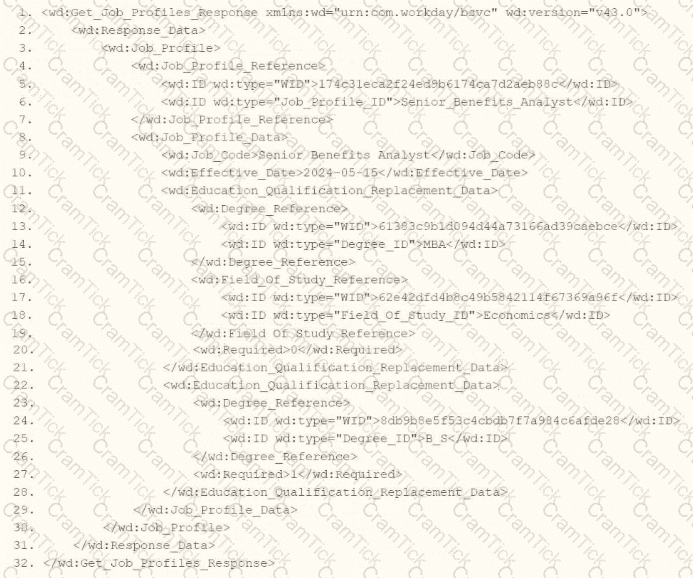
You are an integration developer and need to write XSLT to transform the output of an EIB which is making a request to the Get Job Profiles web service operation. The root template of your XSLT matches on the < wd:Get_Job_Profiles_Response > element. This root template then applies templates against < wd:Job_Profile > . XPath contains a number of delivered functions such as format-date. The format-date function uses the following syntax: format-date ($value as xs: date? $picture as xs:string). Within the template which matches on < wd:Job_Profile > , what XPath syntax would you use to output the value of the < wd:Effective_Date > element formatted with the day-month-year format of " 15-07-2024 " ?
Refer to the scenario. You are configuring a Core Connector: Worker integration with the Data Initialization Service (DIS) enabled to extract worker demographic and contact information. The integration must include worker fields such as name, address, and a calculated field identifying workers eligible for a phone allowance.
The Phone Allowance Type calculated field exists and is functional in the tenant, but it is not displaying in the output.
What configuration step should you complete to include this field in the output?
Refer to the scenario. You are configuring a Core Connector: Worker integration with the Data Initialization Service (DIS) enabled. The integration must extract worker contact details and job information, including a calculated field override that determines phone allowance eligibility.
When testing, you run the Test Security Related Action from the Configure Integration Field Override step. Several field overrides display “No” in the Available by User column.
To ensure the ISSG has access to these field overrides and that “Yes” is displayed in the Test Security step, what configuration should you review?
Refer to the following scenario to answer the question below.
You have configured a Core Connector: Worker integration, which utilizes the following basic configuration:
• Integration field attributes are configured to output the Position Title and Business Title fields from the Position Data section.
• Integration Population Eligibility uses the field Is Manager which returns true if the worker holds a manager role.
• Transaction Log service has been configured to Subscribe to specific Transaction Types: Position Edit Event.
You launch your integration with the following date launch parameters (Date format of MM/DD/YYYY):
• As of Entry Moment: 05/25/2024 12:00:00 AM
• Effective Date: 05/25/2024
• Last Successful As of Entry Moment: 05/23/2024 12:00:00 AM
• Last Successful Effective Date: 05/23/2024
To test your integration, you made a change to a worker named Jeff Gordon who is not assigned to the manager role. You perform an Edit Position on Jeff Gordon and update their business title to a new value. Jeff Gordon ' s worker history shows the Edit Position Event as being successfully completed with an effective date of 05/24/2024 and an Entry Moment of 05/24/2024 07:58:53 AM however Jeff Gordon does not show up in your output.
What configuration element would have to be modified for the integration to include Jeff Gordon in the output?
Refer to the following scenario to answer the question below.
You are configuring a Core Connector: Worker integration with the Data Initialization Service (DIS) enabled. The integration must extract worker contact details and job information, including a calculated field override that determines phone allowance eligibility.
You need to review and correct the security configuration so that all overrides are secured appropriately and data is successfully extracted, resolving any security issues that arise when testing runs of the integration.
While troubleshooting issues with the connector, you are looking for a report which allows you to see how a given item is secured.
What report or task would assist you in this?
An external system needs a file containing data for total hours of overtime worked for each worker. They would like to receive a file at the end of each month. The file should show compensation changes since the last integration run.
What is the recurrence type of the integration schedule?
What is the task used to upload a new XSLT file for a pre-existing document transformation integration system?
Refer to the following scenario to answer the question below.
You need to configure a Core Connector: Candidate Outbound integration for your vendor. The connector requires the data initialization service (DIS).
The vendor needs the file to only include candidates that undergo a candidate assessment event in Workday.
How do you accomplish this?
Refer to the following XML to answer the question below.
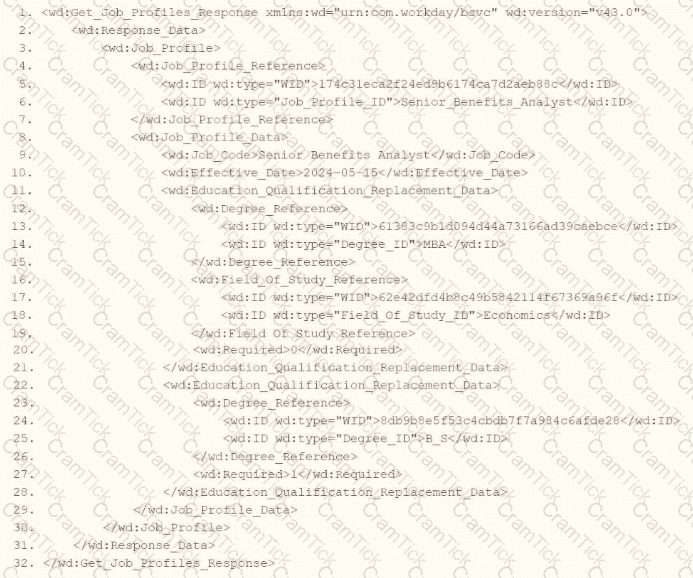
You are an integration developer and need to write XSLT to transform the output of an EIB which is making a request to the Get Job Profiles web service operation. The root template of your XSLT matches on the < wd:Get_Job_Profiles_Response > element. This root template then applies templates against < wd:Job_Profile > . What XPath syntax would be used to select the value of the ID element which has a wd:type attribute named Job_Profile_ID when the < xsl:value-of > element is placed within the template which matches on < wd:Job_Profile > ?
What option for an outbound EIB uses a Workday-delivered transformation to output a format other than Workday XML?
What is a key function and primary benefit of using a Document Transformation Connector within the integration capabilities of Workday?
You have configured a filename sequence generator for a connector integration. The vendor decides that a unique filename is no longer required.
How would you modify the integration to meet this requirement?
Refer to the following XML data source to answer the question below.
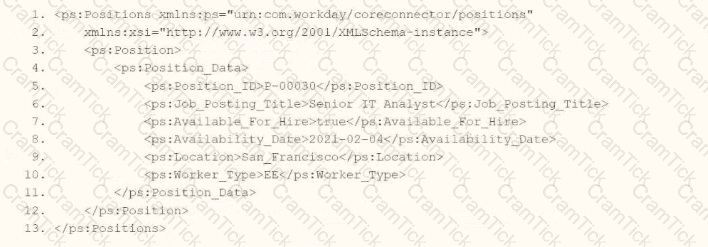
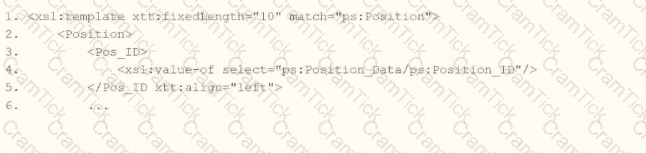
You need the integration file to format the ps:Position_ID field to 10 characters, truncate the value if it exceeds, and align everything to the left.
How will you start your template match on ps:Position to use Document Transformation (DT) to do the transformation using XTT?



Refer to the following scenario to answer the question below.
You have been asked to build an integration using the Core Connector: Worker template and should leverage the Data Initialization Service (DIS). The integration will be used to export a full file (no change detection) for employees only and will include personal data. The vendor receiving the file requires marital status values to be sent using a list of codes that they have provided instead of the text values that Workday uses internally and if a text value in Workday does not align with the vendors list of codes the integration should report " OTHER " .
What configuration is required to output the list of codes required from by the vendor instead of Workday ' s values in this integration?
Your manager has asked for a value on their dashboard for how many days away the birthdays are of their direct reports. The format of the output should be [Worker ' s Name] ' s birthday is in [X] days, where you must calculate the number of days until a Worker ' s next birthday. An example output is " Logan McNeil ' s birthday is in 103 days. "
Which calculated field functions do you need to accomplish this?
The following XML code was generated through a RaaS that will be used in an EIB.
You want to use predicated templates that will process USA workers one way, GBR workers another way, and all other countries a standard way.
What XML code will create these templates?
Refer to the following scenario to answer the question below.
A connector is configured to detect changes to government IDs, personal information, and compensation data. The worker history report below shows recent transactions for a new hire.
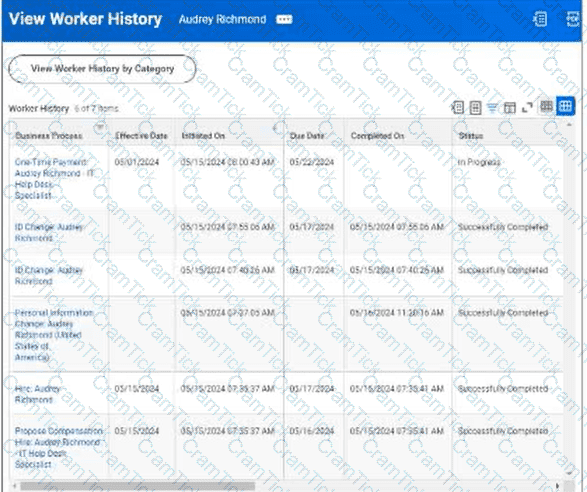
Worker History: Audrey Richmond
The worker history includes a One Time Payment transaction for Audrey Richmond with an effective date of 05/01/2024, initiated on 05/15/2024, due date of 05/17/2024, and status of In Progress. Other transactions shown include ID Change, Personal Information Change, Hire, and Propose Compensation records.
You launch the connector integration to process changes with the following parameters:
As Of Entry Moment: 05/17/2024 12:00:00 AM
Effective Date: 05/17/2024
Last Successful As Of Entry Moment: 05/15/2024 12:00:00 AM
Last Successful Effective Date: 05/15/2024
Why will the integration output file exclude the one-time payment change?
Refer to the following scenario to answer the question below.
You are configuring a Core Connector: Worker integration to send data to a new external compliance and certification tracking vendor. You have begun to configure the connector with the Data Initialization Service (DIS) enabled. Your goal is to extract worker qualification data, but the vendor has three specific requirements:
The file must only include Active workers who are in the “Clinical Staff” Job Family.
The vendor has specified that for each worker’s Education data, they only want to receive the Institution Name, Institution Type and Degree.
The vendor requires a custom “License ID” that must combine the Certification Name and Issuing State, for example, “RN-CA”. A Calculated Field that provides this custom “License ID” already exists in the tenant.
During testing, using a Full File run, the output file is missing all education-related information, even though you believe you have initially configured field attributes such as Institution Name, Institution Type and Degree in the Configure Integration Field Attributes step. Additionally, you confirmed that the Worker Qualification Data Section is marked as Include in Output.
What should you do to resolve this issue?
Refer to the scenario. You are configuring a Core Connector: Worker integration with the Data Initialization Service (DIS) enabled that runs once daily. The integration must extract only active worker records with changes to compensation, home address, or business title since the last run 24 hours ago, using Workday’s change detection to avoid full extracts.
During testing, an employee’s home address is updated, but the integration does not detect the change in the output. The employee is eligible, the connector uses the correct integration field attributes, and the launch parameters are properly configured for a Full-Diff extract.
What configuration task must you modify from the integration system to ensure the expected change is included in the output?
Refer to the following scenario to answer the question below.
You have been asked to build an integration using the Core Connector: Worker template and should leverage the Data Initialization Service (DIS). The integration will be used to export a full file (no change detection) for employees only and will include personal data.
What configuration is required to output the value of a calculated field which you created for inclusion in this integration?
Refer to the following XML and example transformed output to answer the question below.
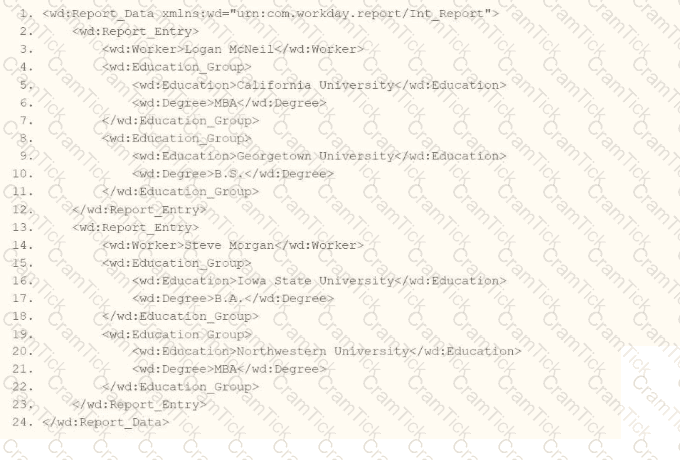
Example transformed wd:Report_Entry output;
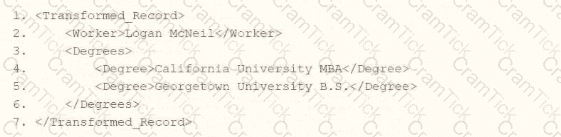
What is the XSLT syntax tor a template that matches on wd: Educationj3roup to produce the degree data in the above Transformed_Record example?

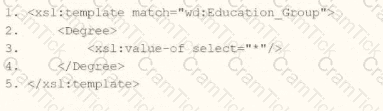
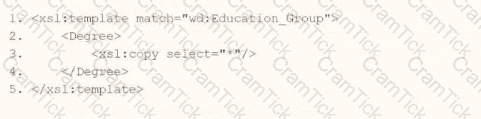
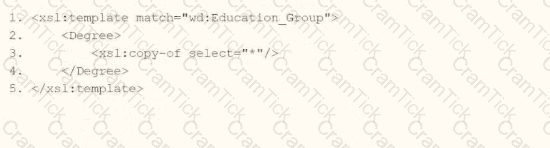
What XSL component is required to execute valid transformation instructions in the XLST code?
Refer to the following XML to answer the question below.
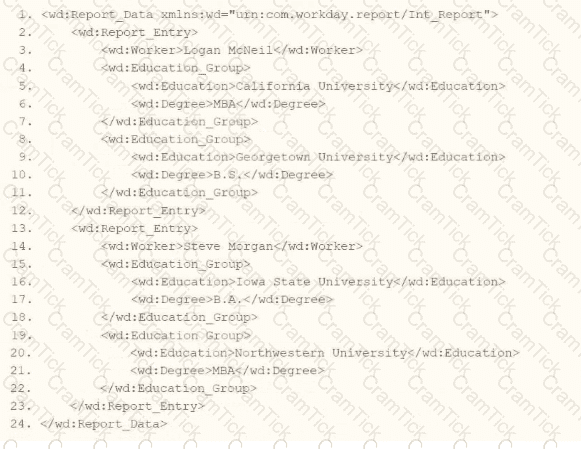
Within the template which matches on wd:Report_Entry, you would like to conditionally process the wd:Education_Group elements by using an < xsl:apply-templates > element. What XPath syntax would be used for the select to iterate over only the wd:Education_Group elements where the Degree is an MBA?
A vendor needs an EIB that uses a custom report to output data for payroll results. You have been asked to create a calculated field that will be used to output the highest deduction from a worker’s payroll results.
Which calculated field functions do you use to accomplish this?
An external system needs a file containing data for recent compensation changes. They would like to receive a file routinely at 5 PM eastern standard time, excluding weekends. The file should show compensation changes since the last integration run.
What is the recurrence type of the integration schedule?
Refer to the following XML to answer the question below.
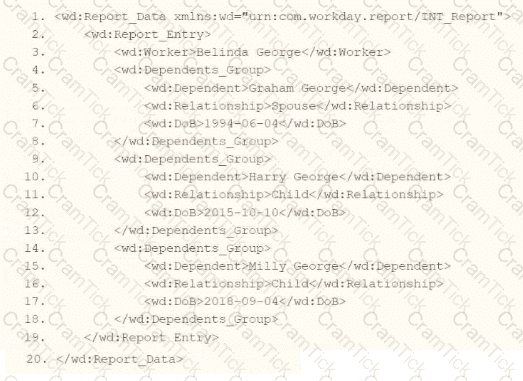
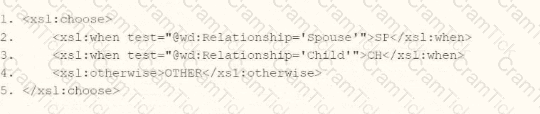
You are an integration developer and need to write XSLT to transform the output of an EIB which is using a web service enabled report to output worker data along with their dependents. You currently have a template which matches on wd:Dependents_Group to iterate over each dependent. Within the template which matches on wd:Dependents_Group you would like to output a relationship code by using an < xsl:choose > statement.
What XSLT syntax would be used to output SP when the dependent relationship is spouse, output CH when the dependent relationship is child, otherwise output OTHER?







TESTED 05 Oct 2026