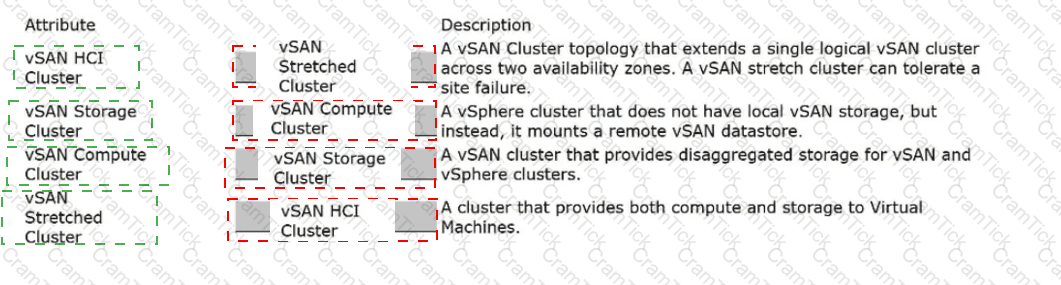
An administrator is preparing to enable vSAN Data-at-Rest Encryption and must verify that the identity and key provider prerequisites are met before proceeding with the configuration.
Which two requirements must be met? (Choose two.)
An administrator has been tasked with suggesting storage models for a new VMware Cloud Foundation (VCF) Private Cloud. The following information has been provided:
• All existing implementations of VMware vSphere use the existing third-party block-based storage solution.
• The block-based storage solution only has sufficient scale, capacity and IOPS to cater for the new workload storage requirements.
• There is a dedicated and highly resilient storage area network connecting hosts to the provided block-based storage.
• There are 5 existing hosts with enough CPU and RAM resources and resilient Host Bus Adapters (HBAs) to cater for the new workload resource requirements only.
• There is sufficient budget to purchase some hardware, however the solution must re-use the existing hardware where possible.
The administrator suggests the following high-level solution:
• Single VCF Instance with a single Workload Domain.
• Deploy 4 new servers to create a Management Domain.
• Repurpose the 5 existing servers to create a single cluster in the Workload Domain.
Which two storage models should the administrator recommend? (Choose two.)
A storage administrator is being presented with the following VMware Cloud Foundation (VCF) architectural details:
• The applications data will require 2.5 PB of capacity.
• The production applications will be hosting archival solutions and gateways.
• There will be some applications deployed for the purpose of testing and development.
What is the optimal principal storage that the administrator can recommend?
An administrator is managing a local vSAN 3-node cluster running the Express Storage Architecture (ESA) as part of a VMware
Cloud Foundation (VCF) Workload Domain.
The following parameters apply at the cluster level:
• HA is enabled
• Reserved Failover Capacity = 25% for both CPU and Memory
The administrator is tasked with configuring the VSAN storage policy so it will tolerate the maximum number of failures.
What two protection levels can the administrator configure? (Choose two.)
The Windows team is planning to deploy a Windows Server Failover Cluster. This requires a disk shared between all members of the cluster.
Which two options are available to fulfill this requirement on a vSAN ESA cluster? (Choose two.)
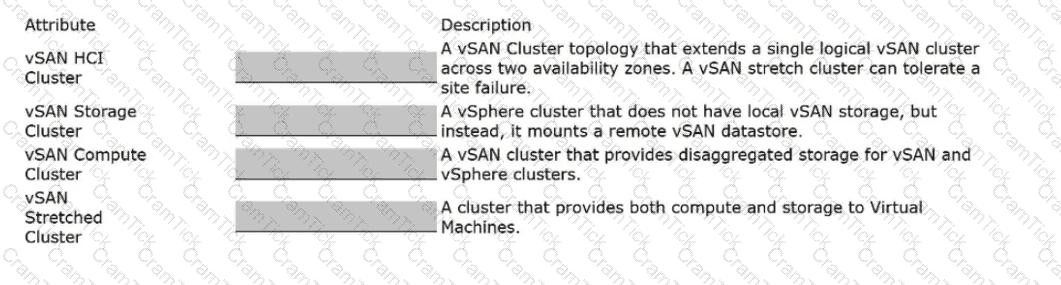
An administrator has deployed a three-host vSphere cluster with a small amount of VMFS storage and wants to add additional capacity from a vSAN ESA cluster located in the same vCenter Server.
When the administrator selects the vSphere cluster and navigates to the Configure tab, the Datastore Management option is missing under the vSAN section.
What prerequisite must be met before the administrator can mount the remote datastore?
A storage architect has been called into a meeting with the accounting team who is trying to determine why 20% of their raw capacity is not available for consumption. Their vSAN cluster was created with the following characteristics:
• 2 x 2 TB NVMe disks in 6 hosts in their vSAN cluster.
• FTT=1, RAID-1 for the default policy.
• Host Rebuild Reserve not activated for this cluster.
Which two items should the Architect say accounts for most of the unusable capacity? (Choose two.)
vSAN encounters a noncompliant Virtual Machine and is able to locate a full replica of 55% of the votes for the noncompliant objects.
What action will vSAN do with the Virtual Machine?
An architect is designing a vSAN storage solution for a remote site. The following requirements have been given:
• There is enough rack space for two hosts, each with 36 CPU cores and 256 GB of RAM.
• The physical network at the remote site supports 10 Gb maximum.
• The network connecting the remote site to corporate has 10 Gb of bandwidth with an average RTT of 25 ms.
• High availability is expected for all the Virtual Machines running at the remote site.
• The solution must provide additional storage to 16 graphic design Windows based workstations.
• Active Directory is configured and available at the remote site.
• The graphic design application requires native NTFS permissions.
What vSAN advanced technology is required for configuring this remote site?
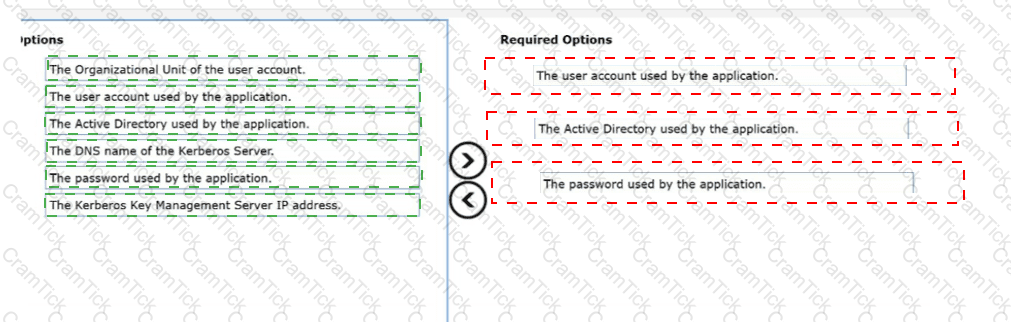
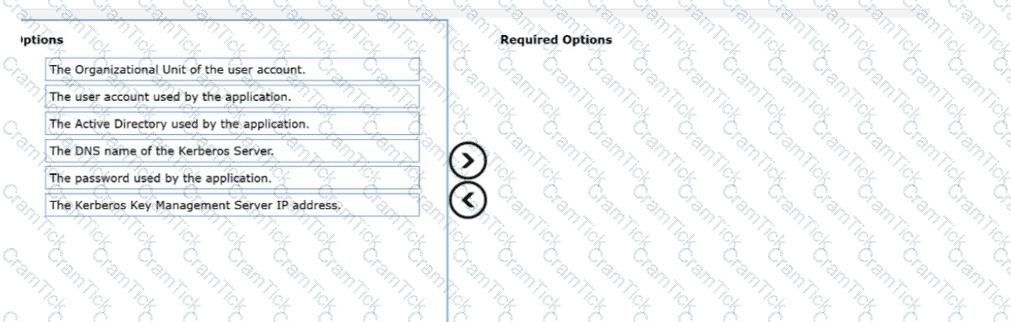
An administrator has been presented with the following requirements from an application owner:
• The application is distributed across multiple data centers.
• The application currently uses NFSv4.1 for mounting data volumes.
• The application requires Kerberos encryption.
Drag and drop the three correct options from the Options list on the left and place them into the Required Options on the right to properly configure the storage solution to meet the requirements in any order. (Choose three.)
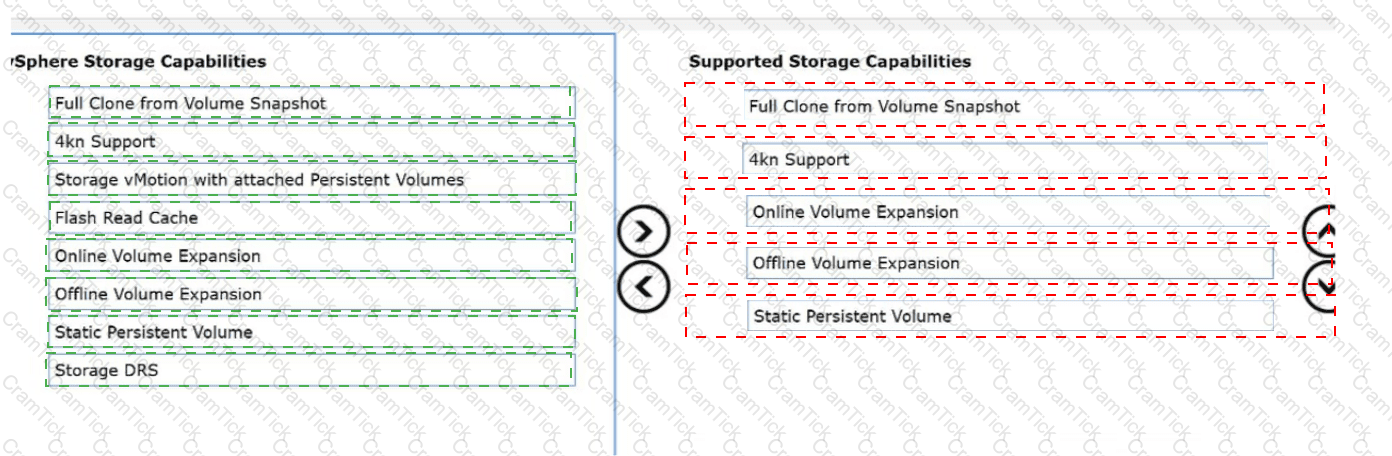
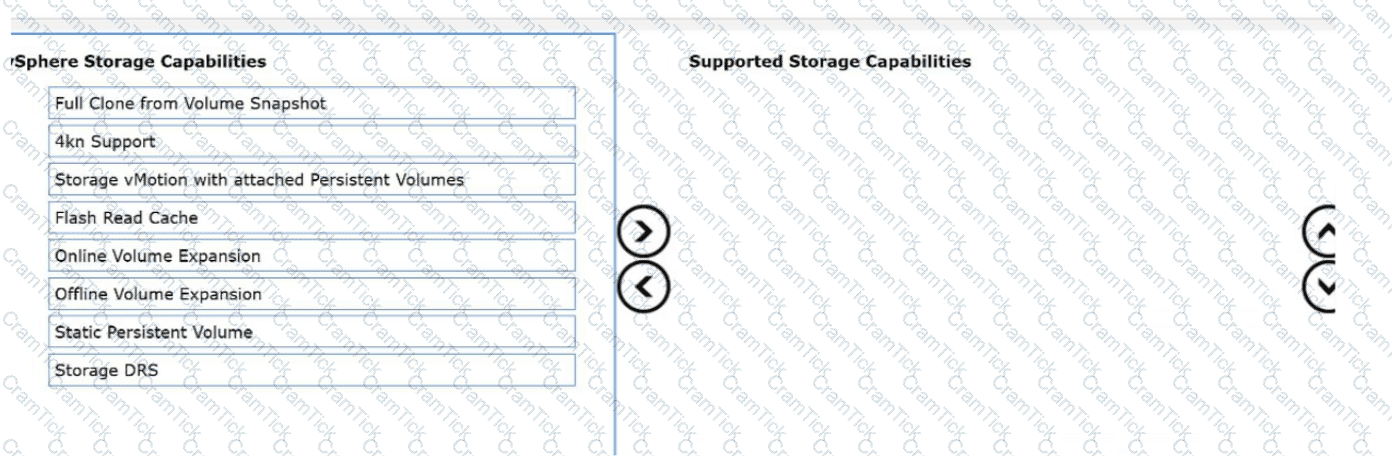
Select the storage capabilities supported for use with persistent volumes in the VMware Kubernetes Service (VKS) in VMware Cloud Foundation (VCF).
Drag and drop the five supported capabilities from the vSphere Storage Capabilities list on the left and place them into the Supported Storage Capabilities list on the right in any order. (Choose five.)
An administrator is managing a stretched vSAN ESA cluster where each site has three hosts.
The following parameters apply to the storage policy being configured at the datastore level:
• The policy is configured at the datastore level
• Site disaster tolerance = Site mirroring - stretched cluster
• Failures to tolerate = 1 failure - RAID-1 (mirroring)
• Number of disk stripes = 1
When inspecting some of the Virtual Machines (VMs), why do objects have 3 disk stripes?
An enterprise is planning to deploy a new vSAN ESA enabled cluster to their existing VMware Cloud Foundation (VCF) Private Cloud Workload Domain. The following requirements have been given:
• 2 x 4 TB NVMe disks per host
• FTT=1/RAID-5 for all deployed Virtual Machines
• Expected dedupe/compression ratio = 1.5 (50%)
• Reserve enough capacity to rebuild a host completely in case of a failure (Host Rebuild Reservation)
• Operational Reserve of 10%
• Expected overhead for filesystem, object, etc. of 25%
How many hosts are required to meet a minimum usable capacity of 12 TB?
An administrator has been tasked with suggesting storage models for a new VMware Cloud Foundation (VCF) Private Cloud with the following characteristics:
• Single VCF Instance with a single Workload Domain.
• The VCF Management Workload Domain will consist of a single cluster that uses a highly scalable, integrated storage solution that does not require additional management software or hardware.
• The VCF Workload Domain consists of a single Cluster that requires a multiple-tier storage solution consisting of:
A highly scalable, policy-based storage solution for critical application workloads.
A file-based storage solution that can scale independently of the cluster for workloads with large data requirements. Which three storage models should the administrator recommend? (Choose three.)
An administrator has been tasked with deploying vSAN Data Protection in a VMware Cloud Foundation (VCF) Workload Domain. The administrator deploys the VMware Live Recovery OVA and logs into the management interface to start the Configure Appliance process, but the appliance fails to register with vCenter.
What are two possible causes the administrator can check to resolve the issue? (Choose two.)
An administrator is responsible for managing a VMware Cloud Foundation (VCF) Private Cloud.
The following information has been provided about the environment:
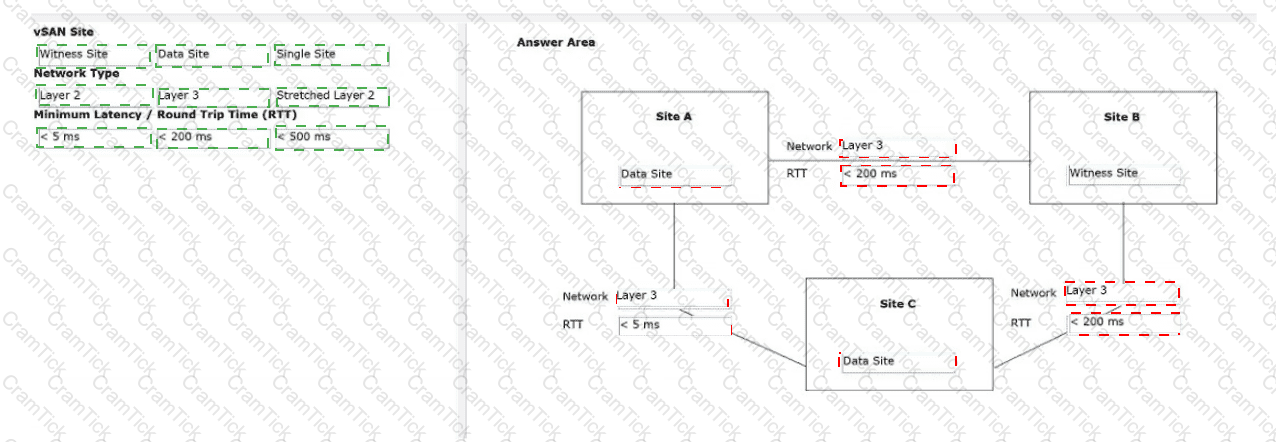
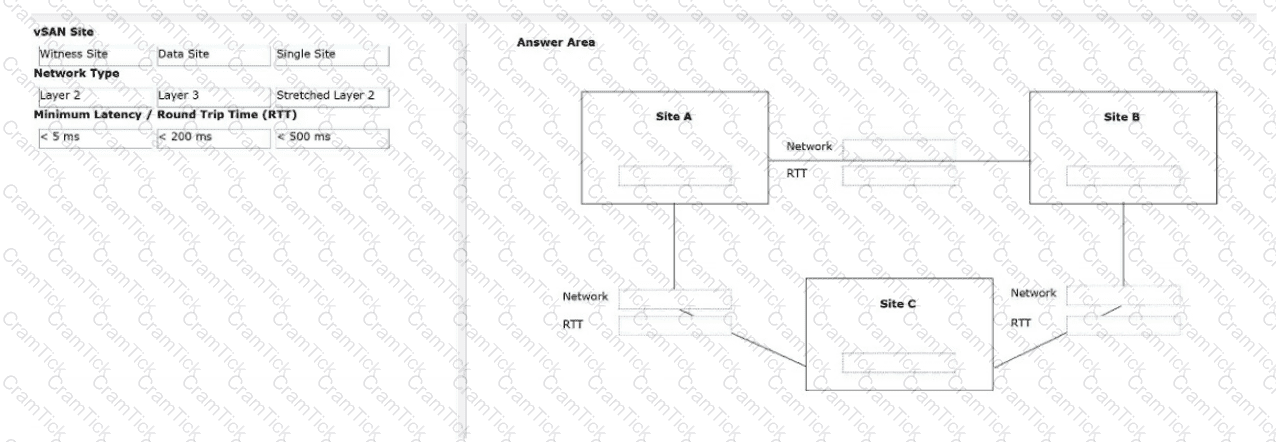
• There are 3 customer datacenters, Site A, Site B and Site C.
• The datacenter at Site A runs all Production Services.
• The datacenter at Site B has reached capacity and there is no space for additional physical hardware.
• The datacenter at Site C has been commissioned to replace Site B, because there is more rack space and power capacity to cater for future demand.
The administrator has been tasked with identifying the networking requirements for a new VMware vSAN Stretched Cluster with the following requirements:
• The solution will deploy a total of 10 new ESX host servers to create a VMware vSAN Stretched Cluster.
• The solution must deploy appropriate networking to ensure minimal disruption from issues with Spanning Tree Protocol (STP).
Drag and drop the correct vSAN Site Type, Networking Type and Round Trip Latency (RTT) within the boxes provided to complete the high-level diagram.
An administrator is planning the deployment of a new VMware Cloud Foundation (VCF) Workload Domain. The storage design decisions for the solution are:
• NFS
• NVMe over RDMA
• No local storage is available to the hosts
What is the storage solution build order for the Workload Domain?
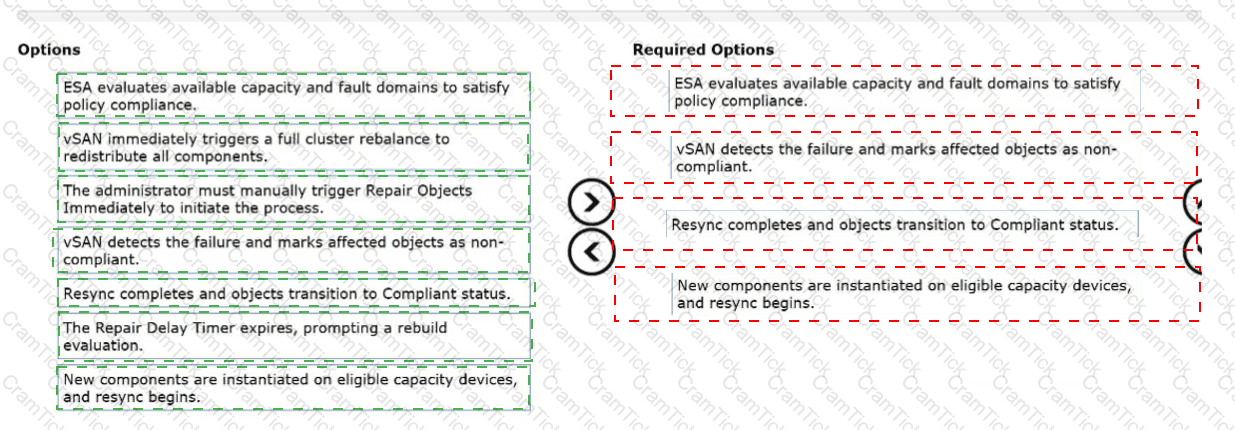
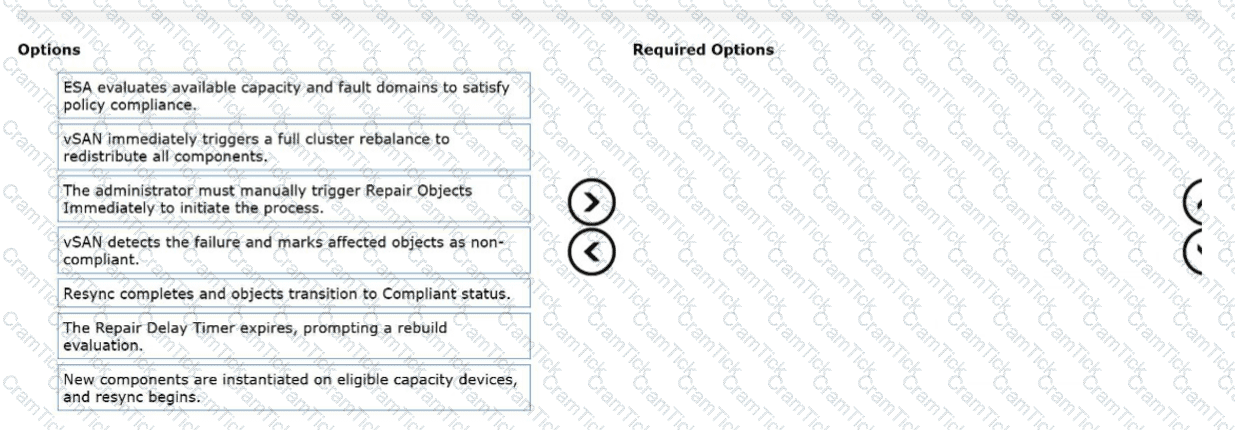
A vSAN ESA cluster experienced a host NVMe failure, causing several objects to become non-compliant.
Select the steps vSAN ESA follows to detect, evaluate and repair the non-compliant objects.
Drag and drop the four correct options from the Options list on the left and place them into the Required Options on the right in any order. (Choose four.)
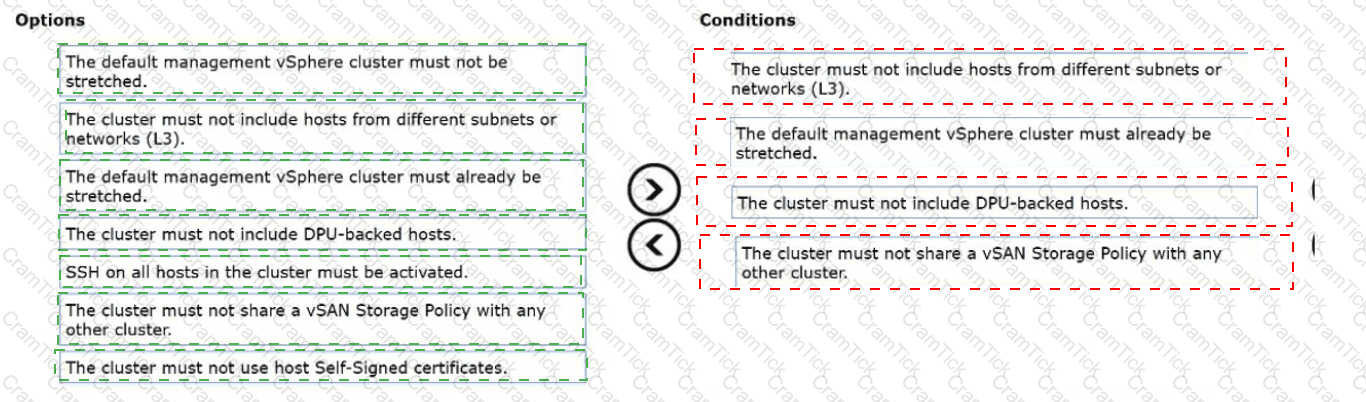
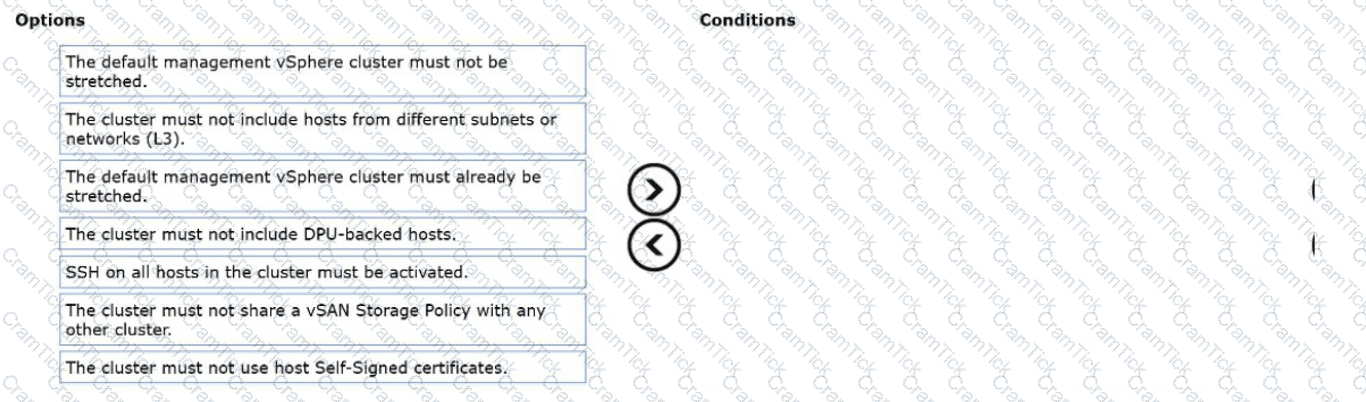
An administrator is tasked with stretching a vSAN cluster in a VMware Cloud Foundation (VCF) Workload Domain across two availability zones within a region. Both availability zones contain an equal number of hosts.
What four Conditions must also be met in order to stretch the cluster?
Drag and drop the four correct options from the Options list on the left and place them into the Conditions on the right in any order. (Choose four.)




TESTED 09 Oct 2026