Manufacturing A.B.C. is an international, mid-sized company that specializes in producing industrial equipment. It has operated in the market for more than two decades and has established itself as a reputable industry player. However, rapid technological advances have left its current network infrastructure outdated and unable to keep pace with the requirements of modern manufacturing processes.
Manufacturing A.B.C.'s network combines multi-vendor legacy wired and wireless components, resulting in frequent downtime and reduced production efficiency. The aging equipment causes slow data-transfer rates, unreliable connectivity, and greater exposure to cyber threats. Fiber cabling also needs upgrading, as OM2 is used predominantly.
Further complicating these network issues, the recent CTO departure has left the company without clear direction for the network-refresh project. The management team has not reached consensus on the scope, budget, or timeline for the upgrade.
The manufacturing customer's primary objectives are as follows:
Improve network performance and reliability to enhance production processes and minimize downtime.
Enhance network security to protect sensitive data and intellectual property.
Streamline communication and collaboration among the organization's different departments.
Ensure scalability for future growth and technological advancements.
Manufacturing A.B.C. is seeking a comprehensive network refresh that includes the following components:
Upgrade the wired infrastructure to high-speed Ethernet switches to support higher data-transfer rates and reduce latency.
Implement a robust wireless solution with enterprise-grade access points to provide seamless connectivity throughout the manufacturing facility.
Use centralized network-management tools to simplify network administration and monitoring.
Expectations:
The customer expects the network-refresh project to be completed efficiently, with minimal disruption to ongoing operations. They seek a reliable, experienced network-solutions provider that understands their unique manufacturing requirements and can deliver a customized solution aligned with their budget constraints. Given the recent CTO change, the manufacturing customer is eager to receive clear project proposals and decision-making support.
As a network-solutions provider, your role is to address these concerns, provide expert guidance, and present a clearly defined plan that meets their objectives effectively.
A manufacturing customer runs a 24/7 production facility and is concerned that the migration could disrupt the production chain.
What are two ways to minimize or eliminate this disruption?
Choose two.
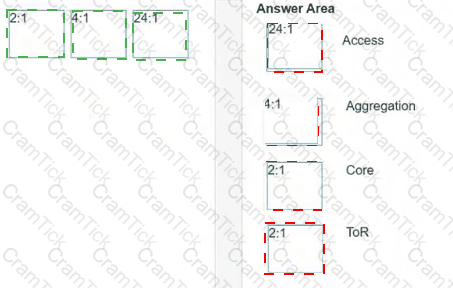
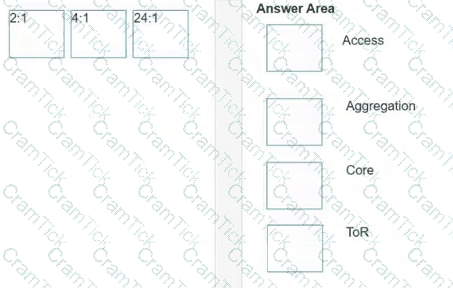
You are using a 3-tier design and need to calculate the oversubscription ratio for the Access, Distribution, Core, and ToR layers.
What is a suitable oversubscription ratio for each layer? Matches may be used more than once or not at all.
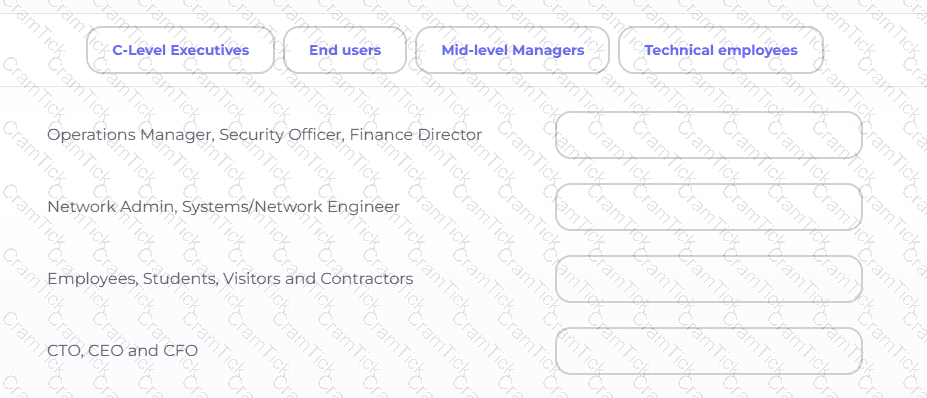
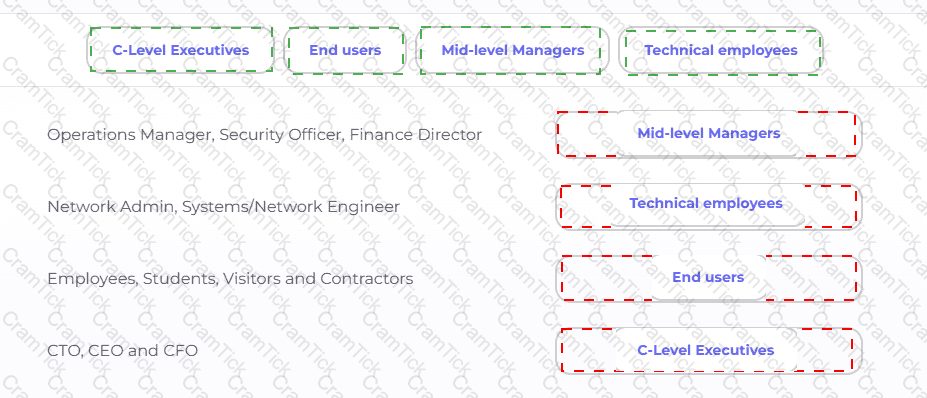
You are meeting with different stakeholders in a customer’s IT organization as part of an HPE Aruba Networking campus access-layer design project. You need to collect technical input that supports design decisions, including switch-port capacity, uplink requirements, and user-connectivity needs.
Which two stakeholders participate in these design activities?
Choose two.
It has been identified that the client’s existing network must retransmit packets because of possible hardware or configuration issues. Hardware configuration and transport reliability will need to be reviewed before completing the new design.
How should this phenomenon be classified?
Original exhibit — Question 47
A large multinational financial institution has engaged you to design a new full-stack wired and wireless network for its new 6-story regional office building. The facility’s bottom two floors will be retail space for a large banking branch. The upper floors will be carpeted corporate office space, with each floor approximately 100,000 sq ft (9290 sq m). Data centers are all offsite and are outside this project’s scope. The customer is underserved by its current L2-based network infrastructure and wants to use modern best practices in the new design. The network must be fully resilient and fault-tolerant, with dynamic segmentation at the edge.
The retail space will provide public guest Wi-Fi access. Retail associates will use corporate tablets for customer service, and the retail floors will contain a mixture of wired and wireless devices. Corporate users will primarily connect wirelessly, although several wired clients, printers, and hard VoIP phones will be used.
The customer also plans to renovate the corporate office space to take advantage of ‘smart office’ technology. These upgrades will enable blue-dot wayfinding, presence analytics, and other location-based services.
After further discussions with the customer, the team determined that EVPN-VXLAN will provide dynamic segmentation. The customer wants to ensure that a particular VNI is present only when it is used on that switch.
Which solution is valid and meets this technical requirement?
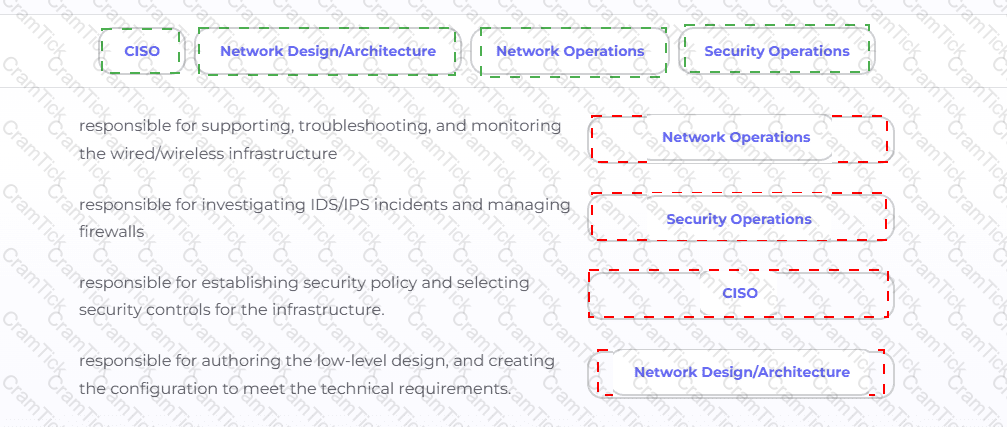
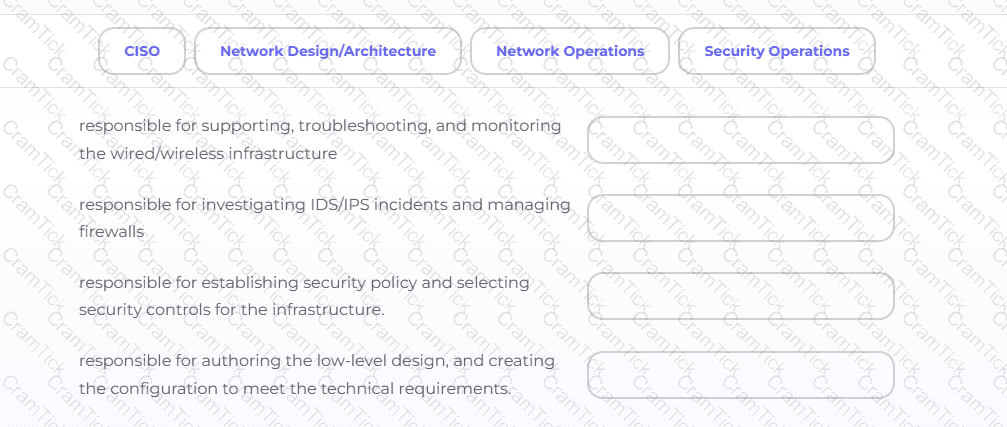
A junior engineer has been hired to help with a large-scale network infrastructure project. Because the engineer has not previously worked on a project this complex, they want to better understand the role each stakeholder will have.
Match each stakeholder title with the responsibility most likely associated with that role.
Manufacturing A.B.C. is an international, mid-sized company that specializes in manufacturing industrial equipment. It has operated in the market for more than two decades and has become a reputable player in its industry. However, rapid technological advances have left its present network infrastructure outdated and unable to keep pace with modern manufacturing-process demands.
Manufacturing A.B.C.'s network combines multi-vendor legacy wired and wireless components, resulting in frequent downtime and reduced production efficiency. Its aging equipment causes slow data-transfer rates, unreliable connectivity, and greater exposure to cyber threats. Fiber cabling should also be upgraded because OM2 is used for the most part.
Further compounding the network problems, the recent departure of the CTO has left the company without a clear course for the network-refresh project. The management team lacks consensus on the upgrade's scope, budget, and timeline.
The manufacturing customer's primary objectives are:
Improve network performance and reliability to improve production processes and minimize downtime.
Strengthen network security to safeguard sensitive data and intellectual property.
Streamline communication and collaboration among the organization's different departments.
Provide scalability for future growth and technological advances.
Manufacturing A.B.C. wants a comprehensive network refresh that includes:
Upgrading the wired infrastructure with high-speed Ethernet switches to support higher data-transfer rates and lower latency.
Deploying a robust wireless solution using enterprise-grade access points to provide seamless connectivity throughout the manufacturing facility.
Centralized network-management tools to simplify network administration and monitoring.
Expectations:
The customer expects the network-refresh project to be completed efficiently, with minimal disruption to ongoing operations. They want a reliable, experienced network-solutions provider that understands their distinctive manufacturing requirements and can deliver a tailored solution that meets their budget constraints. Given the recent CTO change, the manufacturing customer is eager to receive clear project proposals and decision-making support.
As the network-solutions provider, your role is to address these concerns, provide expert guidance, and present a clearly defined plan that effectively meets their objectives.
Assume that the current network infrastructure has no wireless shadow-IT equipment operating across the different floors/production sites, but you want to confirm this. How can you determine whether wireless shadow-IT equipment is currently in operation?
During the stakeholder interview, an agenda is created to clarify customer expectations. The customer is concerned about future business requirements, with network scalability and flexibility being key.
Which expectations should be considered to solve upcoming business problems?
Choose two.
A global cruise-line company needs to modernize its existing fleet. To make the ships more cost-effective and sustainable, it will refresh the ship “insides” and replace all WLAN/LAN hardware. This refresh will not change the company’s current security requirements. The CIO also wants to minimize unused switch ports. Any future expansion will always require a hardware refresh. The effort begins with the smallest ship, which supports a maximum of 800 guests.
Each ship has a LAN infrastructure comprising two core switches, up to 10 redundant distribution switches, and up to 500 access switches (400 cabins and 100 technical rooms). The core switches are in the ship’s MDF, and the distribution switches are in the IDFs. Every cabin and technical room receives one access switch.
The ship’s cabling structure will remain unchanged. Each IDF connects to the MDF through SMF, with two pairs available for the core-to-distribution interconnect. The SM fiber between the MDF and IDF is under 300 meters (980 ft) and is OS1. Each cabin connects to the IDF through one OM2 pair, at a maximum length of 60 meters (200 ft). Each technical room connects to the IDF through one OM2 pair, with lengths from 100 to 150 meters (320 to 500 ft).
For every cabin and technical room, the customer wants to replace the existing fan-less 2530/2540 switches without altering requirements, except that the uplink to the distribution switch must be upgraded to 10GbE to accommodate increased network traffic, and technical rooms require redundant power.
The WLAN infrastructure will be refreshed 1:1, with no new cabling or AP locations. It is based on 200/300-series indoor and outdoor APs running InstantOS (fewer than 300 APs), and the customer has no WLAN requirement changes.
The cruise-line company will replace its current Internet connection before the LAN/WLAN refresh. The new connection will deliver 99.8% uptime, needed to keep paid guest Wi-Fi continuously operational. Because this Internet connection is guaranteed, the CIO wants the design based on Aruba’s ESP architecture.
Based on best practices, which switch model is the most cost-effective choice for the distribution layer?
You are planning a secure onboarding solution for a customer’s enterprise network. The plan includes HPE Aruba Networking ClearPass Policy Manager (CPPM) Onboard to simplify device onboarding and enforce security policies.
Which critical design considerations and feature recommendations should be included in your proposal to ensure a smooth, effective implementation?
Choose two.
During a stakeholder interview, an agenda is developed to clarify their expectations for the network design project.
Which two topics emphasize the customer's experience with their network?
Choose two.
Which platforms can be used to demonstrate your solution to a customer?
Choose two.
The current IT staff is accustomed to working with legacy OS-S (ProCurve) equipment. They are concerned that the differing command syntax will prevent them from handling OS-CX switches.
Which two methods can make their transition easier? (Select two.)
Choose two.
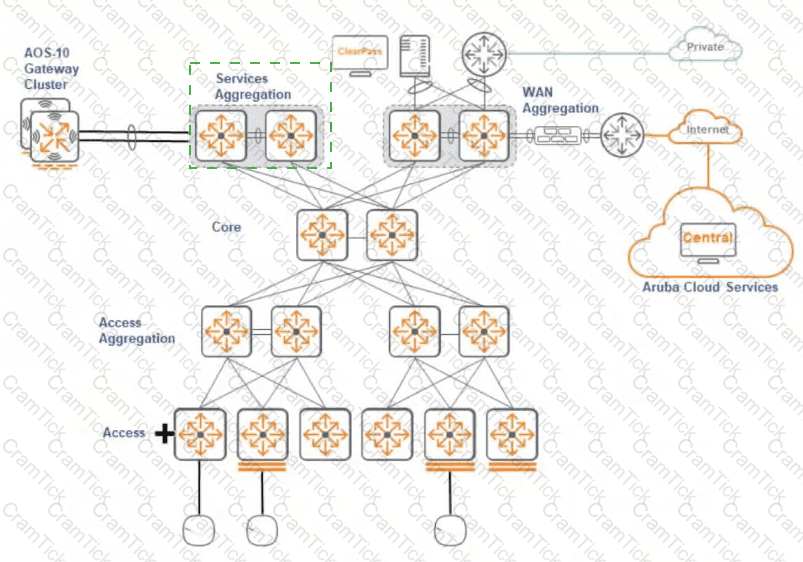
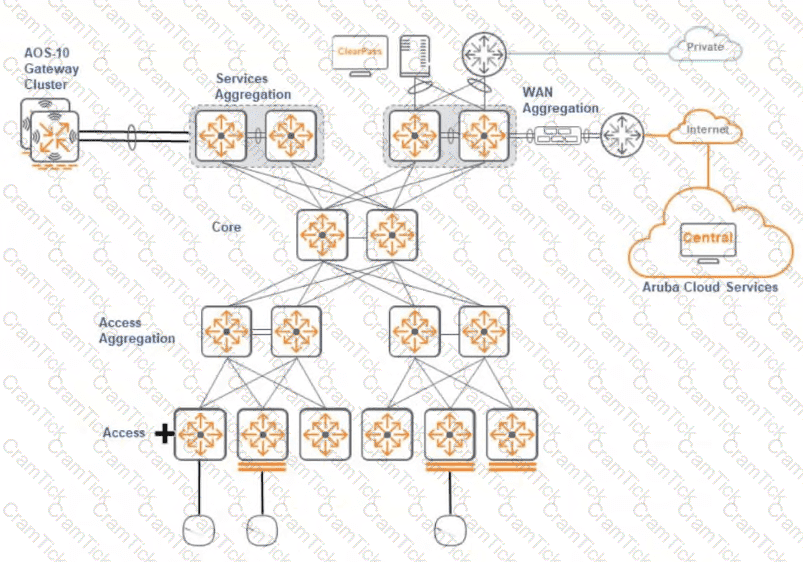
Based on this campus design, click the layer that is most appropriate to design as a Stub Persona when considering an EVPN VXLAN Fabric?
A large multinational financial institution has engaged you to design a new full-stack wired and wireless network for its new 6-story regional office building. The facility’s bottom two floors will be retail space for a large banking branch. The upper floors will be carpeted corporate office space, with each floor approximately 100,000 sq ft (9290 sq m). Data centers are all offsite and are out of scope for this project. The customer is underserved by its current L2-based network infrastructure and wants to use modern best practices in the new design. The network must be fully resilient and fault-tolerant, with dynamic segmentation at the edge.
The retail space will provide public guest Wi-Fi access. Retail associates will use corporate tablets for customer service, with a mix of wired and wireless devices throughout the retail floors. Corporate users will mainly use wireless connectivity, although several wired clients, printers, and hard VoIP phones will also be used.
The customer also plans to renovate the corporate office space to take advantage of 'smart office' technology. These enhancements will enable blue-dot wayfinding, presence analytics, and other location-based services.
The client wants to provide Blue Dot wayfinding for its carpeted office space. The retail floors are not currently in scope.
What is required to ensure the solution is properly licensed?
As part of several technical proposals for a customer deploying both Wi-Fi 7 high-throughput HD and very high-throughput VHD networks based on HPE Aruba Networking AOS-10, you are identifying key considerations for radio frequency (RF) design and channel optimization.
Which statements are recommended AOS-10 best practices for RF planning and should be included in your proposals to deliver optimal wireless performance?
Choose two.
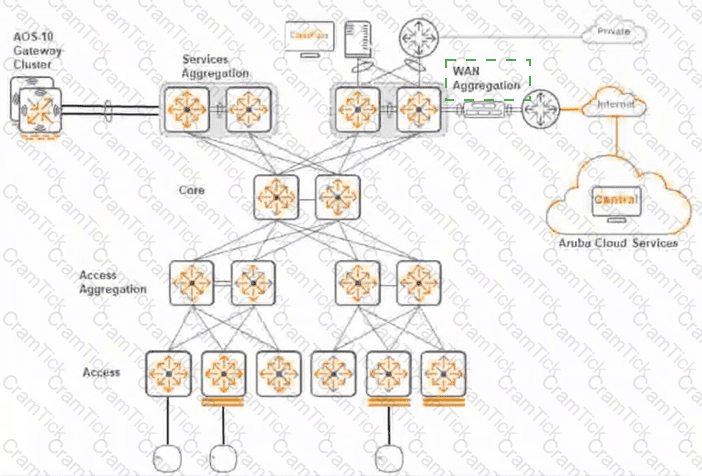
Based on this campus design, select the layer most suitable to be designed as a Border Persona when considering an EVPN VXLAN Fabric.
Original network architecture exhibit
A large multinational financial institution has hired you to design a new full-stack wired and wireless network for its new 6-story regional office building. The lowest two floors of the facility will be retail space for a large banking branch. The upper floors will be carpeted corporate office space, with each floor measuring approximately 100,000 sq ft (9290 sq m). All data centers are offsite and are outside this project’s scope. The customer is underserved by its current L2-based network infrastructure and wants to apply modern best practices in the new design. The network must be fully resilient and fault-tolerant, with dynamic segmentation at the edge.
The retail space will provide public guest Wi-Fi access. Retail associates will use corporate tablets for customer service, and the retail floors will contain a mix of wired and wireless devices. Corporate users will primarily connect wirelessly, although several wired clients, printers, and hard VoIP phones will also be used.
The customer also plans to renovate the corporate office space to take advantage of 'smart office' technology. These enhancements will enable blue-dot wayfinding, presence analytics, and other location-based services.
The client wants to use lower-cost OS-CX switches in its wiring closets. It calculates that each closet will require a stack of qty 6 POE (AT) and qty 4 Gigabit Ethernet switches, stacked with low-cost DACs.
Which switch series should you recommend?
You are presenting the customer with a replacement collapsed-core network proposal in which the core switches will have switched virtual interfaces (SVIs) configured. The customer is unsure whether a VSX switch pair can serve as the spanning-tree root in its environment.
Which statements about spanning tree and VSX would help assure the customer that a VSX pair is suitable for a collapsed core?
Choose two.
You are working with a large enterprise customer preparing to deploy HPE Aruba Networking ClearPass Policy Manager (CPPM) across multiple campus locations. They have asked that ClearPass Insight be included in the technical proposal so they can use its historical reporting and analytics capabilities.
As part of the design consultation, the customer specifically wants to understand:
Whether Insight needs additional licensing or subscriptions.
How enabling Insight affects the size and structure of their CPPM cluster.
Which best practices they should follow to enable Insight resiliently and at scale.
Confirm which statements about HPE Aruba Networking ClearPass Insight are accurate so they can plan the correct number of nodes and licensing in the IRIS-generated Bill of Materials.
Choose two.
A colleague has produced a proposed design for a large enterprise customer that uses HPE Aruba Networking AOS-CX 6300 switches at the wired access layer. The customer requires a secure, scalable solution founded on Zero Trust Security (ZTS) principles.
In the current environment, endpoint devices connected to access switches are configured to transmit 802.1Q-tagged frames, and the new design plans to tunnel traffic from the switches to an AOS-10 Gateway cluster by using User-Based Tunneling (UBT) in its default mode.
During a design review, you are asked to determine whether this solution supports the customer requirement to retain endpoint VLAN tags across the tunnel.
You recommend a modification, explaining that the proposed default configuration will not satisfy the customer’s technical requirement.
Which UBT configuration would support the customer requirement to preserve VLAN tagging from the endpoints across the UBT tunnel to the gateway?
Identify the stakeholders when collecting information for the network design and the new IDF/MDF design.
Choose two.
What alternative source is most suitable for site surveys or simu-lations when no floor plans are available?




TESTED 15 Nov 2026