Refer to the exhibit.
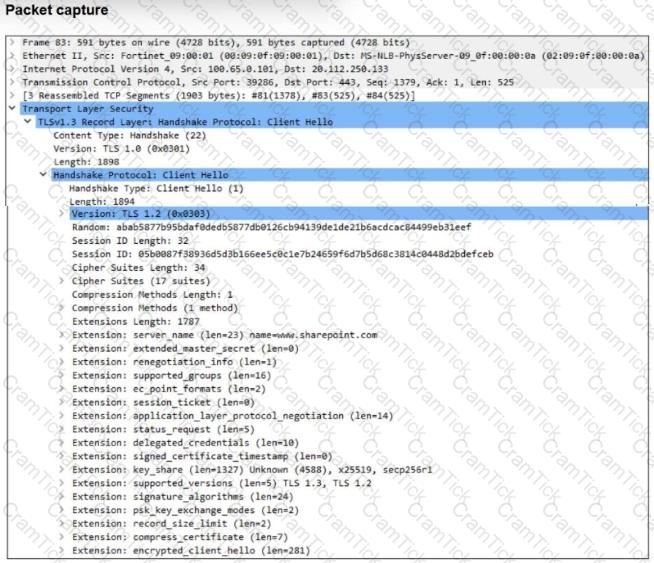
The packet capture output of a client hello message is shown.
You are updating a firewall policy that includes SSL certificate inspection. You are capturing packets from the traffic passing through this firewall policy.
Which two statements about the packet capture are correct? (Choose two.)
During the maintenance window, an administrator must sniff all the traffic going through a specific firewall policy, which is handled by NP6 interfaces. The output of the sniffer trace provides just a few packets.
Why is the output of sniffer trace limited?
What is the initial step performed by FortiGate when handling the first packets of a session?
Refer to the exhibit, which shows a corporate network and a new remote office network.
An administrator must integrate the new remote office network with the corporate enterprise network.
What must the administrator do to allow routing between the two networks?
An administrator configured the FortiGate devices in an enterprise network to join the Fortinet Security Fabric. The administrator has a list of IP addresses that must be blocked by the data center firewall. This list is updated daily.
How can the administrator automate a firewall policy with the daily updated list?
Why does the ISDB block layers 3 and 4 of the OSI model when applying content filtering? (Choose two.)
Which action should you take after applying a block-all IPS profile that caused applications to stop working?
Refer to the exhibit, which shows the ADVPN IPsec interface representing the VPN IPsec phase 1 from Hub A to Spoke 1 and Spoke 2, and from Hub В to Spoke 3 and Spoke 4.
An administrator must configure an ADVPN using IBGP and EBGP to connect overlay network 1 with 2.
What must the administrator configure in the phase 1 VPN IPsec configuration of the ADVPN tunnels?
An administrator needs to install an IPS profile without triggering false positives that can impact applications and cause problems with the user ' s normal traffic flow.
Which action can the administrator take to prevent false positives on IPS analysis?
The IT department discovered during the last network migration that all zero phase selectors in phase 2 IPsec configurations impacted network operations.
What are two valid approaches to prevent this during future migrations? (Choose two.)
You are using Virtual eXtensible LAN (VXLAN) extensively on FortiGate. Which specialized acceleration hardware must you use to improve FortiGate performance? (Choose one answer)
Refer to the exhibit, which shows an enterprise network connected to an internet service provider.
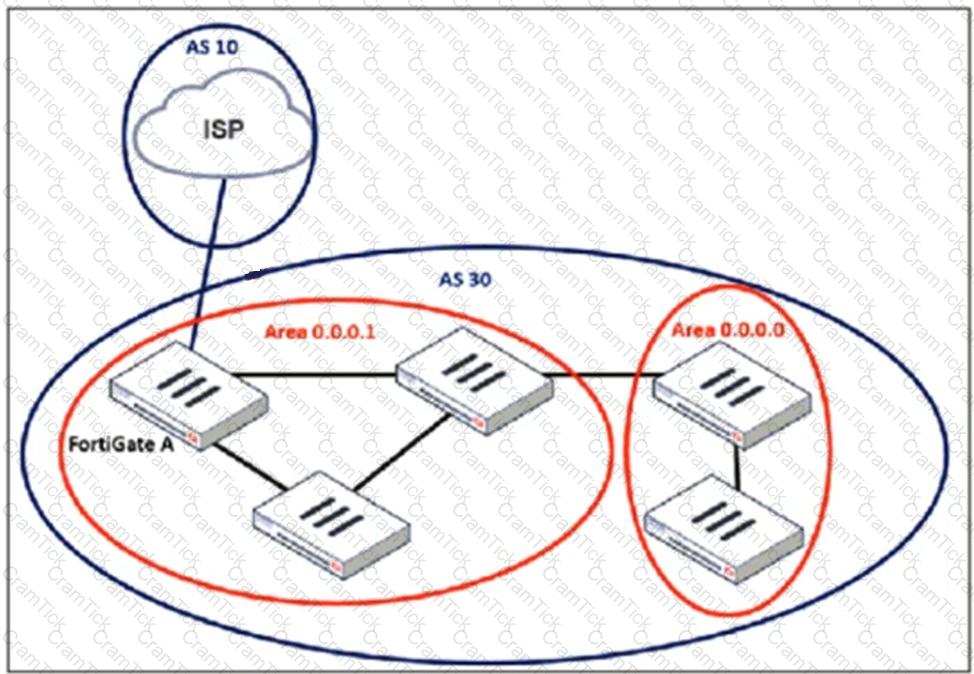
An administrator must configure a loopback as a BGP source to connect to the ISP.
Which two commands are required to establish the connection? (Choose two.)
Refer to the exhibit, which shows the packet capture output of a three-way handshake between FortiGate and FortiManager Cloud.
What two conclusions can you draw from the exhibit? (Choose two.)
You must configure a loopback as a BGP source to connect to the ISP.
Which two commands must you use to establish the connection? (Choose two.)
You configured the FortiGate devices in an enterprise network to join the Fortinet Security Fabric. You have a list of IP addresses that must be blocked by the data center firewall. This list is updated daily.
How can you automate updates to the firewall policy to add the IP addresses from the daily updated list?
An administrator is designing an ADVPN network for a large enterprise with spokes that have varying numbers of internet links. They want to avoid a high number of routes and peer connections at the hub.
Which method should be used to simplify routing and peer management?
Refer to the exhibit, which shows a network diagram.
An administrator would like to modify the MED value advertised from FortiGate_1 to a BGP neighbor in the autonomous system 30.
What must the administrator configure on FortiGate_1 to implement this?
A vulnerability scan report has revealed that a user has generated traffic to the website example.com (10.10.10.10) using a weak SSL/TLS version supported by the HTTPS web server.
What can the firewall administrator do to block all outdated SSL/TLS versions on any HTTPS web server to prevent possible attacks on user traffic?
Refer to the exhibit, which shows the HA status of an active-passive cluster.
An administrator wants FortiGate_B to handle the Core2 VDOM traffic.
Which modification must the administrator apply to achieve this?




TESTED 03 Oct 2026