New Year Limited Time 70% Discount Offer - Ends in 0d 00h 00m 00s - Coupon code: cramtick70

MuleSoft-Platform-Architect-I Salesforce Certified MuleSoft Platform Architect (Mule-Arch-201) Questions and Answers

Questions 4

Mule applications that implement a number of REST APIs are deployed to their own subnet that is inaccessible from outside the organization.

External business-partners need to access these APIs, which are only allowed to be invoked from a separate subnet dedicated to partners - called Partner-subnet. This subnet is accessible from the public internet, which allows these external partners to reach it.

Anypoint Platform and Mule runtimes are already deployed in Partner-subnet. These Mule runtimes can already access the APIs.

What is the most resource-efficient solution to comply with these requirements, while having the least impact on other applications that are currently using the APIs?

Options:

A.

Implement (or generate) an API proxy Mule application for each of the APIs, then deploy the API proxies to the Mule runtimes

B.

Redeploy the API implementations to the same servers running the Mule runtimes

C.

Add an additional endpoint to each API for partner-enablement consumption

D.

Duplicate the APIs as Mule applications, then deploy them to the Mule runtimes

Buy Now
Questions 5

An API has been updated in Anypoint exchange by its API producer from version 3.1.1 to 3.2.0 following accepted semantic versioning practices and the changes have been communicated via the APIs public portal. The API endpoint does NOT change in the new version. How should the developer of an API client respond to this change?

Options:

A.

The API producer should be requested to run the old version in parallel with the new one

B.

The API producer should be contacted to understand the change to existing functionality

C.

The API client code only needs to be changed if it needs to take advantage of the new features

D.

The API clients need to update the code on their side and need to do full regression

Buy Now
Questions 6

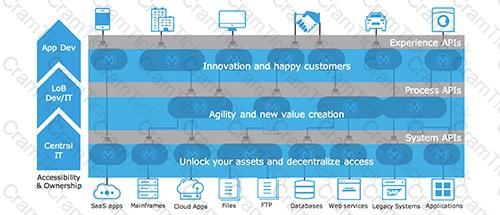
Refer to the exhibit. An organization needs to enable access to their customer data from both a mobile app and a web application, which each need access to common fields as well as certain unique fields.

The data is available partially in a database and partially in a 3rd-party CRM system.

What APIs should be created to best fit these design requirements?
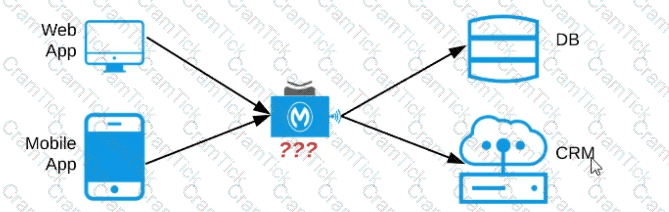
A) A Process API that contains the data required by both the web and mobile apps, allowing these applications to invoke it directly and access the data they need thereby providing the flexibility to add more fields in the future without needing API changes

B) One set of APIs (Experience API, Process API, and System API) for the web app, and another set for the mobile app

C) Separate Experience APIs for the mobile and web app, but a common Process API that invokes separate System APIs created for the database and CRM system
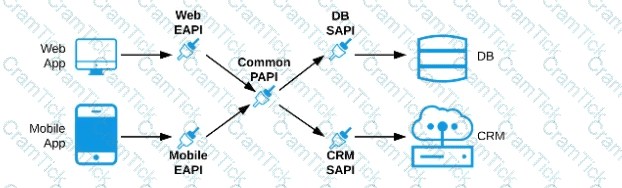
D) A common Experience API used by both the web and mobile apps, but separate Process APIs for the web and mobile apps that interact with the database and the CRM System

Options:

A.

Option A

B.

Option B

C.

Option C

D.

Option D

Buy Now
Questions 7

A customer wants to monitor and gain insights about the number of requests coming in a given time period as well as to measure key performance indicators

(response times, CPU utilization, number of active APIs).

Which tool provides these data insights?

Options:

A.

Anypoint Monitoring

B.

APT Manager

C.

Runtime Alerts

D.

Functional Monitoring

Buy Now
Questions 8

Several times a week, an API implementation shows several thousand requests per minute in an Anypoint Monitoring dashboard, Between these bursts, the

dashboard shows between two and five requests per minute. The API implementation is running on Anypoint Runtime Fabric with two non-clustered replicas, reserved vCPU 1.0

and vCPU Limit 2.0.

An API consumer has complained about slow response time, and the dashboard shows the 99 percentile is greater than 120 seconds at the time of the complaint. It also shows

greater than 90% CPU usage during these time periods.

In manual tests in the QA environment, the API consumer has consistently reproduced the slow response time and high CPU usage, and there were no other API requests at

this time. In a brainstorming session, the engineering team has created several proposals to reduce the response time for requests.

Which proposal should be pursued first?

Options:

A.

Increase the vCPU resources of the API implementation

B.

Modify the API client to split the problematic request into smaller, less-demanding requests

C.

Increase the number of replicas of the API implementation

D.

Throttle the APT client to reduce the number of requests per minute

Buy Now
Questions 9

Say, there is a legacy CRM system called CRM-Z which is offering below functions:

1. Customer creation

2. Amend details of an existing customer

3. Retrieve details of a customer

4. Suspend a customer

Options:

A.

Implement a system API named customerManagement which has all the functionalities wrapped in it as various operations/resources

B.

Implement different system APIs named createCustomer, amendCustomer, retrieveCustomer and suspendCustomer as they are modular and has seperation of concerns

C.

Implement different system APIs named createCustomerInCRMZ, amendCustomerInCRMZ, retrieveCustomerFromCRMZ and suspendCustomerInCRMZ as they are modular and has seperation of concerns

Buy Now
Questions 10

A Mule application exposes an HTTPS endpoint and is deployed to three CloudHub workers that do not use static IP addresses. The Mule application expects a high volume of client requests in short time periods. What is the most cost-effective infrastructure component that should be used to serve the high volume of client requests?

Options:

A.

A customer-hosted load balancer

B.

The CloudHub shared load balancer

C.

An API proxy

D.

Runtime Manager autoscaling

Buy Now
Questions 11

What is most likely NOT a characteristic of an integration test for a REST API implementation?

Options:

A.

The test needs all source and/or target systems configured and accessible

B.

The test runs immediately after the Mule application has been compiled and packaged

C.

The test is triggered by an external HTTP request

D.

The test prepares a known request payload and validates the response payload

Buy Now
Questions 12

What best describes the Fully Qualified Domain Names (FQDNs), also known as DNS entries, created when a Mule application is deployed to the CloudHub Shared Worker Cloud?

Options:

A.

A fixed number of FQDNs are created, IRRESPECTIVE of the environment and VPC design

B.

The FQDNs are determined by the application name chosen, IRRESPECTIVE of the region

C.

The FQDNs are determined by the application name, but can be modified by an administrator after deployment

D.

The FQDNs are determined by both the application name and the Anypoint Platform organization

Buy Now
Questions 13

An API experiences a high rate of client requests (TPS) vwth small message paytoads. How can usage limits be imposed on the API based on the type of client application?

Options:

A.

Use an SLA-based rate limiting policy and assign a client application to a matching SLA tier based on its type

B.

Use a spike control policy that limits the number of requests for each client application type

C.

Use a cross-origin resource sharing (CORS) policy to limit resource sharing between client applications, configured by the client application type

D.

Use a rate limiting policy and a client ID enforcement policy, each configured by the client application type

Buy Now
Questions 14

Due to a limitation in the backend system, a system API can only handle up to 500 requests per second. What is the best type of API policy to apply to the system API to avoid overloading the backend system?

Options:

A.

Rate limiting

B.

HTTP caching

C.

Rate limiting - SLA based

D.

Spike control

Buy Now
Questions 15

A customer wants to host their MuleSoft applications in CloudHub 1.0, and these applications should be available at the domain https://api.acmecorp.com.

After creating a dedicated load balancer (DLB) called acme-dib-prod, which further action must the customer take to complete the configuration?

Options:

A.

Configure the DLB with a TLS certificate for api.acmecorp.com and create an A record for api.acmecorp.com to the public IP addresses associated with their DLB

B.

Configure the DLB with a TLS certificate for api.acmecorp.com and create a CNAME record from api.acmecorp.com to acme-dib-prod.|lb.anypointdns.net

C.

Configure the DLB with a TLS certificate for acme-dib-prod.Jb.anypointdns.net and create a CNAME record from api.acmecorp:com to acme-dlb-prod.lb.anypointdns.net

D.

Configure the DLB with a TLS certificate for aplacmecorp.com and create a CNAME record from api.aomecorp.com to acme-dib-prod.ei.cloubhub.io

Buy Now
Questions 16

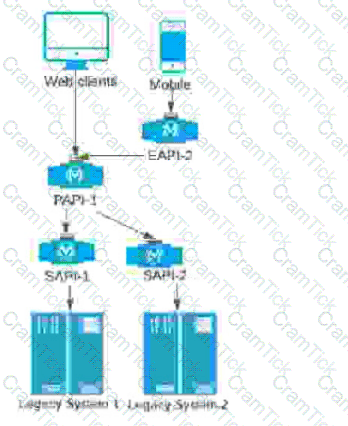
A company stores financial transaction data in two legacy systems. For each legacy system, a separate, dedicated System API (SAPI) exposes data for that legacy system. A Process API (PAPI) merges the data retrieved from ail of the System APIs into a common format. Several API clients call the PAPI through its public domain name.

The company now wants to expose a subset of financial data to a newly developed mobile application that uses a different Bounded Context Data Model. The company wants to follow MuleSoft's best practices for building out an effective application network.

Following MuleSoft's best practices, how can the company expose financial data needed by the mobile application in a way that minimizes the impact on the currently running API clients, API implementations, and support asset reuse?

Options:

A.

Add two new Experience APIs (EAPI-i and EAPI-2}. Add Mobile PAPI-2 to expose the Intended subset of financial data as requested. Both PAPIs access the Legacy Systems via SAPI-1 and SAP]-2.

B.

Add two new Experience APIs (EAPI-i and EAPI-2}. Add Mobile PAPI-2 to expose the Intended subset of financial data as requested. Both PAPIs access the Legacy Systems via SAPI-1 and SAP]-2.

C.

Create a new mobile Experince API (EAPI) chat exposes that subset of PAPI endpoints.Add transformtion login to the mobile Experince API implementation to make mobile data compatible with the required PAPIs.
D.

Develop and deploy is new PAPI implementation with data transformation and ... login to support this required endpoints of both mobile and web clients.Deploy an API Proxy with an endpoint from API Manager that redirect the existing PAPI endpoints to the new PAPI.

Buy Now
Questions 17

A customer has an ELA contract with MuleSoft. An API deployed to CloudHub is consistently experiencing performance issues. Based on the root cause analysis, it is

determined that autoscaling needs to be applied.

How can this be achieved?

Options:

A.

Configure a policy so that when the number of HTTP requests reaches a certain threshold the number of workers/replicas increases (horizontal scaling)

B.

Configure two separate policies: When CPU and memory reach certain threshold, increase the worker/replica type (vertical sealing) and the number of workers/replicas (horizontal sealing)

C.

Configure a policy based on CPU usage so that CloudHub auto-adjusts the number of workers/replicas (horizontal scaling)

D.

Configure a policy so that when the response time reaches a certain threshold the worker/replica type increases (vertical scaling)

Buy Now
Questions 18

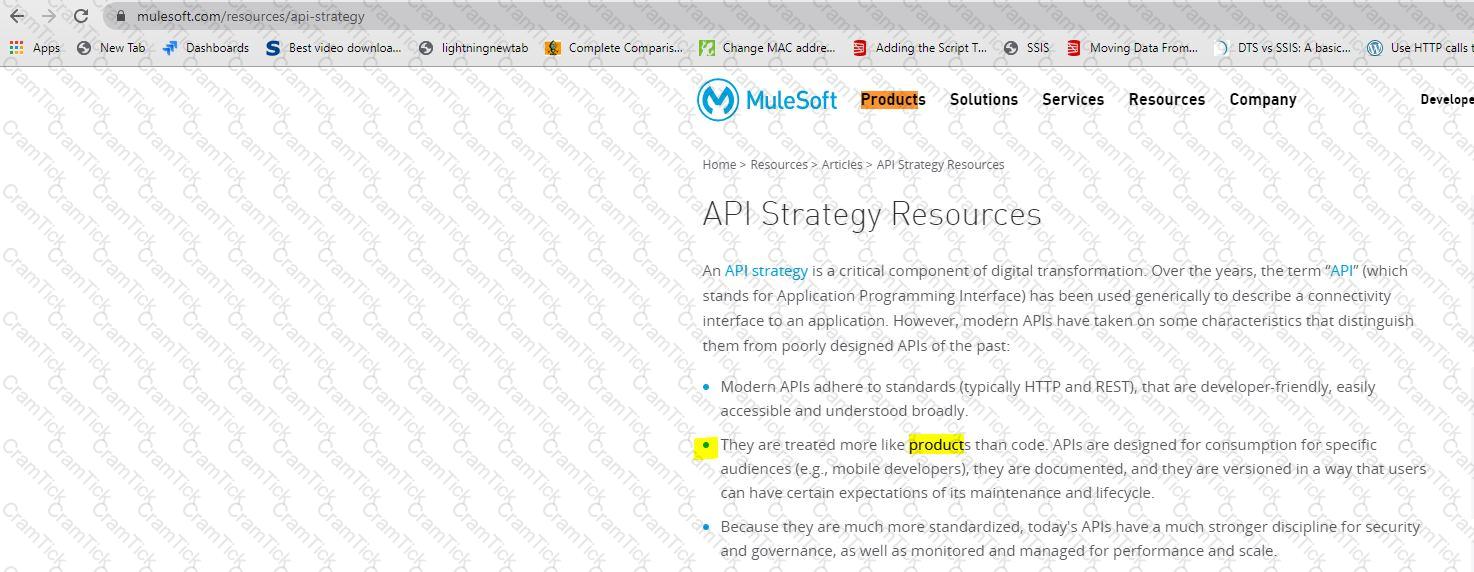
An organization makes a strategic decision to move towards an IT operating model that emphasizes consumption of reusable IT assets using modern APIs (as defined by MuleSoft).

What best describes each modern API in relation to this new IT operating model?

Options:

A.

Each modern API has its own software development lifecycle, which reduces the need for documentation and automation

B.

Each modem API must be treated like a product and designed for a particular target audience (for instance, mobile app developers)

C.

Each modern API must be easy to consume, so should avoid complex authentication mechanisms such as SAML or JWT D

D.

Each modern API must be REST and HTTP based

Buy Now
Questions 19

A set of tests must be performed prior to deploying API implementations to a staging environment. Due to data security and access restrictions, untested APIs cannot be granted access to the backend systems, so instead mocked data must be used for these tests. The amount of available mocked data and its contents is sufficient to entirely test the API implementations with no active connections to the backend systems. What type of tests should be used to incorporate this mocked data?

Options:

A.

Integration tests

B.

Performance tests

C.

Functional tests (Blackbox)

D.

Unit tests (Whitebox)

Buy Now
Questions 20

What Mule application deployment scenario requires using Anypoint Platform Private Cloud Edition or Anypoint Platform for Pivotal Cloud Foundry?

Options:

A.

When it Is required to make ALL applications highly available across multiple data centers

B.

When it is required that ALL APIs are private and NOT exposed to the public cloud

C.

When regulatory requirements mandate on-premises processing of EVERY data item, including meta-data

D.

When ALL backend systems in the application network are deployed in the organization's intranet

Buy Now
Questions 21

What condition requires using a CloudHub Dedicated Load Balancer?

Options:

A.

When cross-region load balancing is required between separate deployments of the same Mule application

B.

When custom DNS names are required for API implementations deployed to customer-hosted Mule runtimes

C.

When API invocations across multiple CloudHub workers must be load balanced

D.

When server-side load-balanced TLS mutual authentication is required between API implementations and API clients

Buy Now
Questions 22

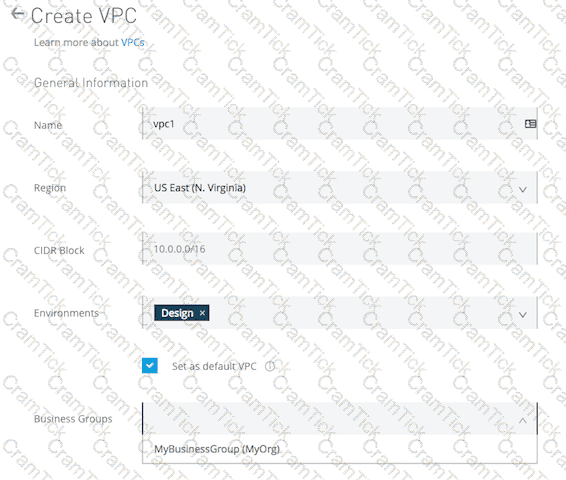
What is true about the technology architecture of Anypoint VPCs?

Options:

A.

The private IP address range of an Anypoint VPC is automatically chosen by CloudHub

B.

Traffic between Mule applications deployed to an Anypoint VPC and on-premises systems can stay within a private network

C.

Each CloudHub environment requires a separate Anypoint VPC

D.

VPC peering can be used to link the underlying AWS VPC to an on-premises (non AWS) private network

Buy Now
Questions 23

What correctly characterizes unit tests of Mule applications?

Options:

A.

They test the validity of input and output of source and target systems

B.

They must be run in a unit testing environment with dedicated Mule runtimes for the environment

C.

They must be triggered by an external client tool or event source

D.

They are typically written using MUnit to run in an embedded Mule runtime that does not require external connectivity

Buy Now
Questions 24

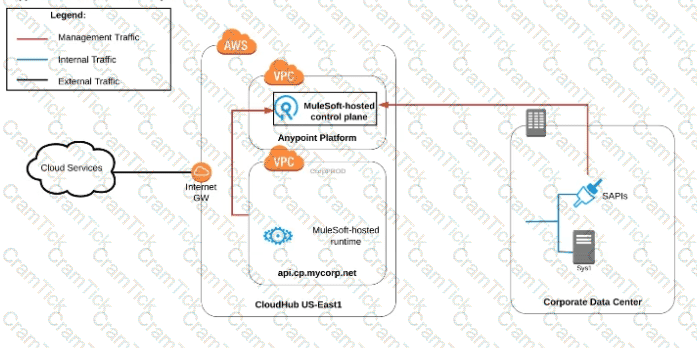
An organization uses various cloud-based SaaS systems and multiple on-premises systems. The on-premises systems are an important part of the organization's application network and can only be accessed from within the organization's intranet.

What is the best way to configure and use Anypoint Platform to support integrations with both the cloud-based SaaS systems and on-premises systems?

A) Use CloudHub-deployed Mule runtimes in an Anypoint VPC managed by Anypoint Platform Private Cloud Edition control plane

B) Use CloudHub-deployed Mule runtimes in the shared worker cloud managed by the MuleSoft-hosted Anypoint Platform control plane

C) Use an on-premises installation of Mule runtimes that are completely isolated with NO external network access, managed by the Anypoint Platform Private Cloud Edition control plane

D) Use a combination of Cloud Hub-deployed and manually provisioned on-premises Mule runtimes managed by the MuleSoft-hosted Anypoint Platform control plane
Options:

A.

Option A

B.

Option B

C.

Option C

D.

Option D

Buy Now
Questions 25

An organization wants to make sure only known partners can invoke the organization's APIs. To achieve this security goal, the organization wants to enforce a Client ID Enforcement policy in API Manager so that only registered partner applications can invoke the organization's APIs. In what type of API implementation does MuleSoft recommend adding an API proxy to enforce the Client ID Enforcement policy, rather than embedding the policy directly in the application's JVM?

Options:

A.

A Mule 3 application using APIkit

B.

A Mule 3 or Mule 4 application modified with custom Java code

C.

A Mule 4 application with an API specification

D.

A Non-Mule application

Buy Now
Questions 26

Which out-of-the-box key performance indicator measures the success of a typical Center for Enablement and is immediately available in responses from Anypoint Platform APIs?

Options:

A.

Per business group, the ratio of the number of production APT implementations deployed using a C1/CD pipeline to the number of production API implementations deployed manually

B.

Per deployed API implementation, the amount of bandwidth consumed each day

C.

Per published API, the number of developers that downloaded s version of the API specification

D.

Per published API, the number of consumers that requested access to the API and have been approved in the Production environment

Buy Now
Questions 27

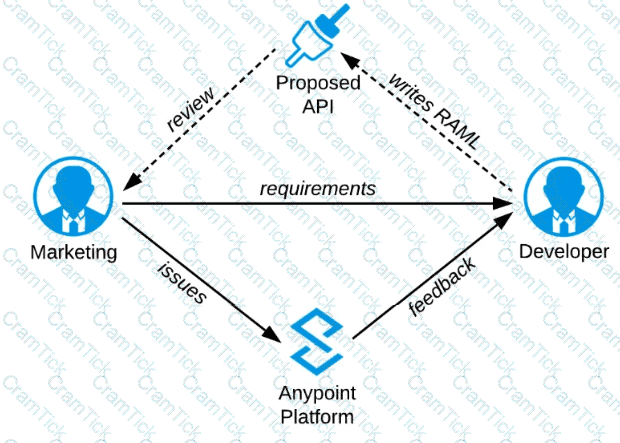
Refer to the exhibit.

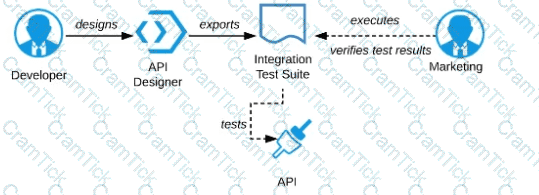
A RAML definition has been proposed for a new Promotions Process API, and has been published to Anypoint Exchange.

The Marketing Department, who will be an important consumer of the Promotions API, has important requirements and expectations that must be met.

What is the most effective way to use Anypoint Platform features to involve the Marketing Department in this early API design phase?

A) Ask the Marketing Department to interact with a mocking implementation of the API using the automatically generated API Console

B) Organize a design workshop with the DBAs of the Marketing Department in which the database schema of the Marketing IT systems is translated into RAML

C) Use Anypoint Studio to Implement the API as a Mule application, then deploy that API implementation to CloudHub and ask the Marketing Department to interact with it

D) Export an integration test suite from API designer and have the Marketing Department execute the tests In that suite to ensure they pass
Options:

A.

Option A

B.

Option B

C.

Option C

D.

Option D

Buy Now
Questions 28

Refer to the exhibit. An organization is running a Mule standalone runtime and has configured Active Directory as the Anypoint Platform external Identity Provider. The organization does not have budget for other system components.

What policy should be applied to all instances of APIs in the organization to most effecuvelyKestrict access to a specific group of internal users?

Options:

A.

Apply a basic authentication - LDAP policy; the internal Active Directory will be configured as the LDAP source for authenticating users

B.

Apply a client ID enforcement policy; the specific group of users will configure their client applications to use their specific client credentials

C.

Apply an IP whitelist policy; only the specific users' workstations will be in the whitelist

D.

Apply an OAuth 2.0 access token enforcement policy; the internal Active Directory will be configured as the OAuth server

Buy Now
Questions 29

A company deploys Mule applications with default configurations through Runtime Manager to customer-hosted Mule runtimes. Each Mule application is an API

implementation that exposes RESTful interfaces to API clients. The Mule runtimes are managed by the MuleSoft-hosted control plane. The payload is never used by any Logger

components.

When an API client sends an HTTP request to a customer-hosted Mule application, which metadata or data (payload) is pushed to the MuleSoft-hosted control plane?

Options:

A.

Only the data

B.

No data

C.

The data and metadata

D.

Only the metadata

Buy Now
Questions 30

How are an API implementation, API client, and API consumer combined to invoke and process an API?

Options:

A.

The API consumer creates an API implementation, which receives API invocations from an API such that they are processed for an API client

B.

The API client creates an API consumer, which receives API invocations from an API such that they are processed for an API implementation

C.

The ApI consumer creates an API client, which sends API invocations to an API such that they are processed by an API implementation

D.

The ApI client creates an API consumer, which sends API invocations to an API such that they are processed by an API implementation

Buy Now
Questions 31

What is a typical result of using a fine-grained rather than a coarse-grained API deployment model to implement a given business process?

Options:

A.

A decrease in the number of connections within the application network supporting the business process

B.

A higher number of discoverable API-related assets in the application network

C.

A better response time for the end user as a result of the APIs being smaller in scope and complexity

D.

An overall tower usage of resources because each fine-grained API consumes less resources

Buy Now
Questions 32

What is the most performant out-of-the-box solution in Anypoint Platform to track transaction state in an asynchronously executing long-running process implemented as a Mule application deployed to multiple CloudHub workers?

Options:

A.

Redis distributed cache

B.

java.util.WeakHashMap

C.

Persistent Object Store

D.

File-based storage

Buy Now
Questions 33

An Order API must be designed that contains significant amounts of integration logic and involves the invocation of the Product API.

The power relationship between Order API and Product API is one of "Customer/Supplier", because the Product API is used heavily throughout the organization and is developed by a dedicated development team located in the office of the CTO.

What strategy should be used to deal with the API data model of the Product API within the Order API?

Options:

A.

Convince the development team of the Product API to adopt the API data model of the Order API such that the integration logic of the Order API can work with one consistent internal data model

B.

Work with the API data types of the Product API directly when implementing the integration logic of the Order API such that the Order API uses the same (unchanged) data types as the Product API

C.

Implement an anti-corruption layer in the Order API that transforms the Product API data model into internal data types of the Order API

D.

Start an organization-wide data modeling initiative that will result in an Enterprise Data Model that will then be used in both the Product API and the Order API

Buy Now
Questions 34

Select the correct Owner-Layer combinations from below options

Options:

A.

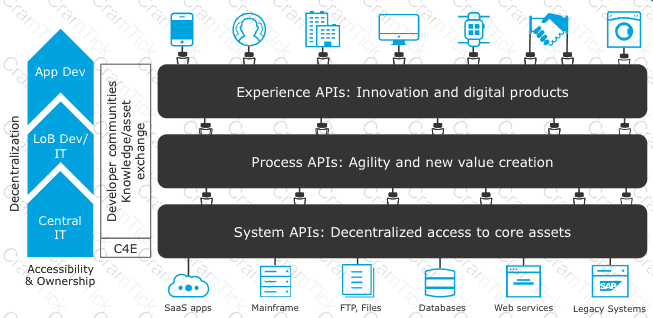
1. App Developers owns and focuses on Experience Layer APIs2. Central IT owns and focuses on Process Layer APIs3. LOB IT owns and focuses on System Layer APIs

B.

1. Central IT owns and focuses on Experience Layer APIs2. LOB IT owns and focuses on Process Layer APIs3. App Developers owns and focuses on System Layer APIs

C.

1. App Developers owns and focuses on Experience Layer APIs2. LOB IT owns and focuses on Process Layer APIs3. Central IT owns and focuses on System Layer APIs

Buy Now
Questions 35

What is typically NOT a function of the APIs created within the framework called API-led connectivity?

Options:

A.

They provide an additional layer of resilience on top of the underlying backend system, thereby insulating clients from extended failure of these systems.

B.

They allow for innovation at the user Interface level by consuming the underlying assets without being aware of how data Is being extracted from backend systems.

C.

They reduce the dependency on the underlying backend systems by helping unlock data from backend systems In a reusable and consumable way.

D.

They can compose data from various sources and combine them with orchestration logic to create higher level value.

Buy Now
Questions 36

Which layer in the API-led connectivity focuses on unlocking key systems, legacy systems, data sources etc and exposes the functionality?

Options:

A.

Experience Layer

B.

Process Layer

C.

System Layer

Buy Now
Questions 37

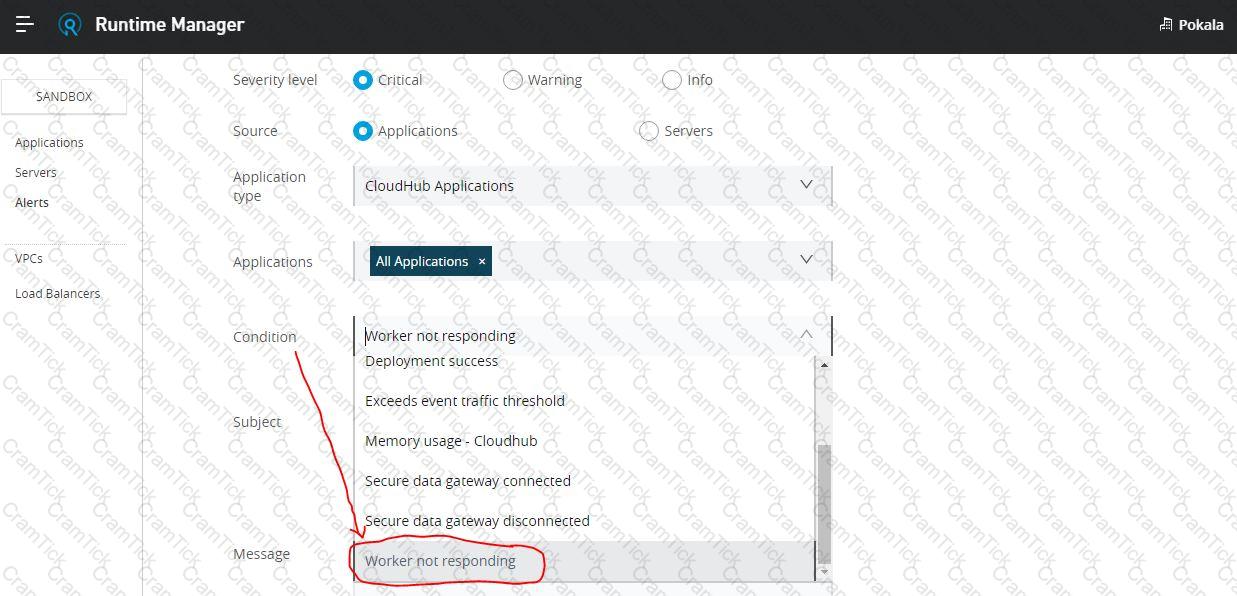
An API implementation is deployed on a single worker on CloudHub and invoked by external API clients (outside of CloudHub). How can an alert be set up that is guaranteed to trigger AS SOON AS that API implementation stops responding to API invocations?

Options:

A.

Implement a heartbeat/health check within the API and invoke it from outside the Anypoint Platform and alert when the heartbeat does not respond

B.

Configure a "worker not responding" alert in Anypoint Runtime Manager

C.

Handle API invocation exceptions within the calling API client and raise an alert from that API client when the API Is unavailable

D.

Create an alert for when the API receives no requests within a specified time period

Buy Now
Questions 38

A new upstream API Is being designed to offer an SLA of 500 ms median and 800 ms maximum (99th percentile) response time. The corresponding API implementation needs to sequentially invoke 3 downstream APIs of very similar complexity.

The first of these downstream APIs offers the following SLA for its response time: median: 100 ms, 80th percentile: 500 ms, 95th percentile: 1000 ms.

If possible, how can a timeout be set in the upstream API for the invocation of the first downstream API to meet the new upstream API's desired SLA?

Options:

A.

Set a timeout of 50 ms; this times out more invocations of that API but gives additional room for retries

B.

Set a timeout of 100 ms; that leaves 400 ms for the other two downstream APIs to complete

C.

No timeout is possible to meet the upstream API's desired SLA; a different SLA must be negotiated with the first downstream API or invoke an alternative API

D.

Do not set a timeout; the Invocation of this API Is mandatory and so we must wait until it responds

Buy Now
Questions 39

A company has started to create an application network and is now planning to implement a Center for Enablement (C4E) organizational model. What key factor would lead the company to decide upon a federated rather than a centralized C4E?

Options:

A.

When there are a large number of existing common assets shared by development teams

B.

When various teams responsible for creating APIs are new to integration and hence need extensive training

C.

When development is already organized into several independent initiatives or groups

D.

When the majority of the applications in the application network are cloud based

Buy Now
Questions 40

Which statement is true about identity management and client management on Anypoint Platform?

Options:

A.

If an external identity provider is configured, the SAML 2.0 bearer tokens issued by the identity provider cannot be used for invocations of the Anypoint Platform web APIs

B.

If an external client provider is configured, it must be configured at the Anypoint Platform organization level and cannot be assigned to individual business groups and environments

C.

Anypoint Platform supports configuring one external identity provider

D.

Both client management and identity management require an identity provider

Buy Now
Questions 41

An application updates an inventory running only one process at any given time to keep the inventory consistent. This process takes 200 milliseconds (.2 seconds) to

execute; therefore, the scalability threshold of the application is five requests per second.

What is the impact on the application if horizontal scaling is applied, thereby increasing the number of Mule workers?

Options:

A.

The application scalability threshold is five requests per second regardless of the horizontal scaling

B.

The total process execution time is now 100 milliseconds (.1 seconds)

C.

The application scalability threshold is now 10 requests per second

D.

Horizontal scaling cannot be applied to an already-running application

Buy Now
Questions 42

An API is protected with a Client ID Enforcement policy and uses the default configuration. Access is requested for the client application to the API, and an approved

contract now exists between the client application and the API

How can a consumer of this API avoid a 401 error "Unauthorized or invalid client application credentials"?

Options:

A.

Send the obtained token as a header in every call

B.

Send the obtained: client_id and client_secret in the request body

C.

Send the obtained clent_id and clent_secret as URI parameters in every call

D.

Send the obtained clent_id and client_secret in the header of every API Request call

Buy Now
Questions 43

A retail company with thousands of stores has an API to receive data about purchases and insert it into a single database. Each individual store sends a batch of purchase data to the API about every 30 minutes. The API implementation uses a database bulk insert command to submit all the purchase data to a database using a custom JDBC driver provided by a data analytics solution provider. The API implementation is deployed to a single CloudHub worker. The JDBC driver processes the data into a set of several temporary disk files on the CloudHub worker, and then the data is sent to an analytics engine using a proprietary protocol. This process usually takes less than a few minutes. Sometimes a request fails. In this case, the logs show a message from the JDBC driver indicating an out-of-file-space message. When the request is resubmitted, it is successful. What is the best way to try to resolve this throughput issue?

Options:

A.

se a CloudHub autoscaling policy to add CloudHub workers

B.

Use a CloudHub autoscaling policy to increase the size of the CloudHub worker

C.

Increase the size of the CloudHub worker(s)

D.

Increase the number of CloudHub workers

Buy Now
Questions 44

In which layer of API-led connectivity, does the business logic orchestration reside?

Options:

A.

System Layer

B.

Experience Layer

C.

Process Layer

Buy Now
Questions 45

A developer from the Central IT team has created an initial version of the RAML definition in Design Center for an OAuth 2.0-protected System API and published it

to Exchange. Another developer from LoB IT discovered the System API in Exchange and would like to leverage it in the Process API.

What is the MuleSoft-recommended approach for Process API to invoke the System API?

Options:

A.

The Process API needs to import an CAuth 2.0 module from Exchange first and update it with OAuth 2.0 credentials before the System API can be invoked

B.

The Process API uses property YAML files to store the System API URLs and uses the HTTP Request Connector to invoke the Systerm API

C.

The Process APL uses the REST Connect Connector autogenerated in Exchange for the System API

D.

The Process API manually updates the Process API POM file to include the System API as a dependency

Buy Now
Exam Name: Salesforce Certified MuleSoft Platform Architect (Mule-Arch-201)
Last Update: Jan 5, 2026
Questions: 152
MuleSoft-Platform-Architect-I pdf

MuleSoft-Platform-Architect-I PDF

$25.5  $84.99
MuleSoft-Platform-Architect-I Engine

MuleSoft-Platform-Architect-I Testing Engine

$30  $99.99
MuleSoft-Platform-Architect-I PDF + Engine

MuleSoft-Platform-Architect-I PDF + Testing Engine

$40.5  $134.99